
Aug 7 2026 | Insights | Emma Bowler
A Connected Factory Isn’t Enough: Why Industry 4.0 Needs Connected Decisions
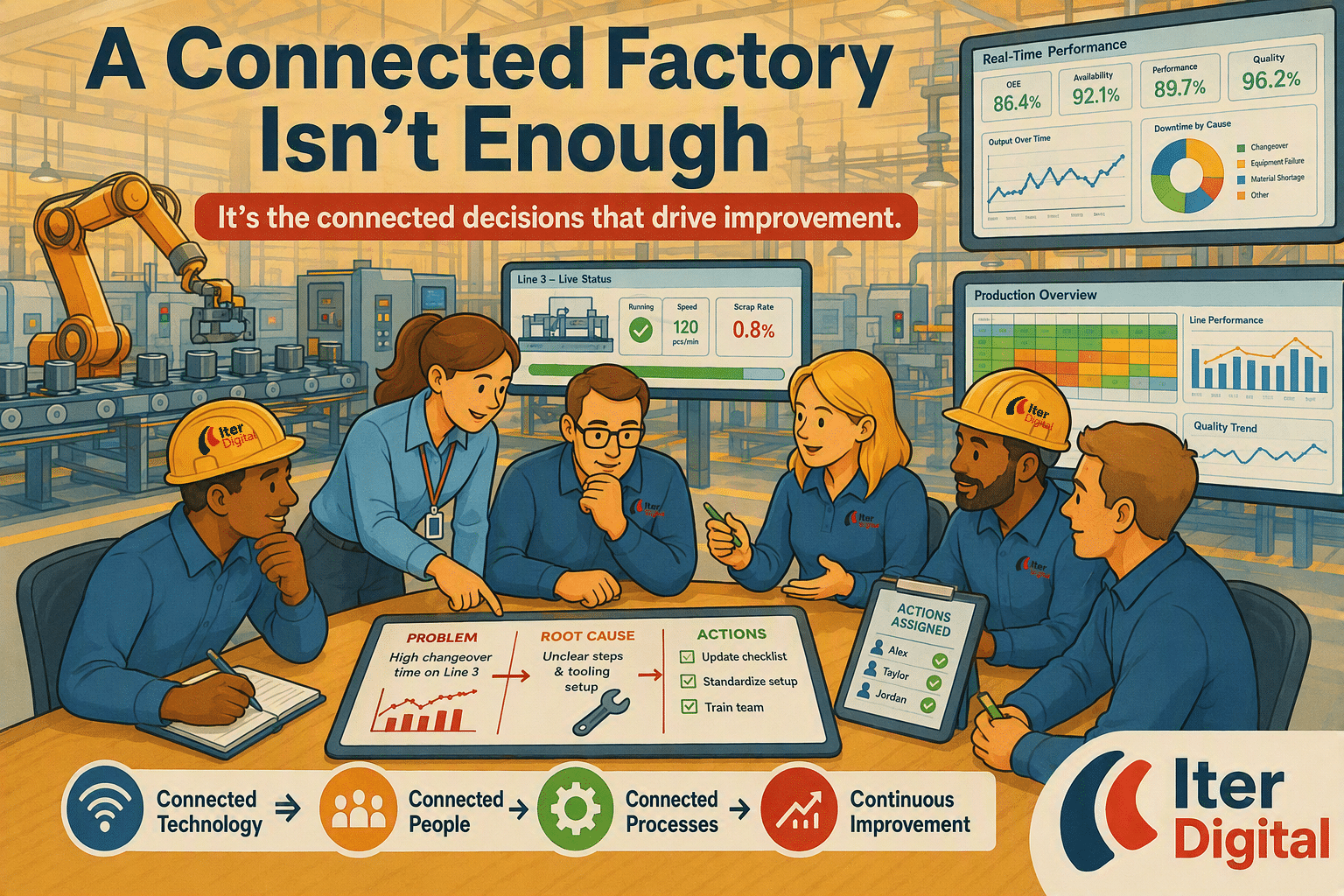
In the era of Industry 4.0, factories are more connected than ever. Machines talk to machines. Production systems capture data. Sensors monitor processes. Dashboards display performance in real time. Manufacturers can see more about their operations than ever before. But there is an important question that often gets overlooked:
What happens when the data tells you there is a problem?
Because connectivity does not automatically create coordination.
A factory can have highly connected equipment, real-time dashboards and vast amounts of operational data, yet still struggle to respond quickly to problems, assign ownership or prevent recurring issues. The challenge for manufacturers is therefore no longer simply about connecting the factory. It is about connecting people, information, decisions and actions.
That is where Digital Lean can play an important role.
What is a connected factory?
A connected factory is a manufacturing environment where machines, equipment, systems, processes and people are digitally connected, allowing information to be captured, shared and used more effectively. This is a fundamental part of Industry 4.0 and smart manufacturing. Production data can be collected automatically. Equipment can report downtime. Quality information can be recorded digitally. Performance dashboards can provide real-time visibility across operations. This creates an enormous amount of useful information. But there is a critical distinction between having connected information and having a connected operating process.
A machine can tell you that it has stopped.
A dashboard can tell you that production is below target.
A quality system can tell you that defects have increased.
But none of these things necessarily tells the organisation:
Why did it happen?
Who needs to act?
What should they do?
Has the problem actually been resolved?
That is the gap between data and action.
When connectivity isn’t enough
Imagine a machine stops unexpectedly.
The production system records the downtime.
The dashboard displays the event.
The information is available almost immediately.
But what happens next?
Perhaps the operator tells the team leader. The team leader makes a note. The problem is discussed at the next meeting. Someone sends an email to maintenance. An action is added to a spreadsheet. The factory is digitally connected. But the response process is disconnected.
The technology has successfully answered:
“What happened?”
It has not necessarily answered:
“Why did it happen, what are we doing about it, and how do we stop it happening again?”
This distinction is particularly important when considering the role of digital technology in Lean manufacturing. Lean has always been about making problems visible and creating a structured response to them. Digital technology can strengthen that process – but only if it connects the information to the people and actions required to improve performance.
The gap between data and action
There is a fundamental difference between visibility and improvement. Data can tell you:
- A machine stopped for 18 minutes
- Production was below target
- A defect rate increased
- Absence affected staffing
- A process missed its standard
- A safety issue was identified
But data alone does not tell you:
- Who needs to act?
- What needs to happen next?
- How urgent is the issue?
- Who owns the action?
- What caused the problem?
- Has the action been completed?
- Did the action actually solve the problem?
- Could the same issue occur elsewhere?
Those questions require a management and improvement process around the data. This is why simply adding more technology does not necessarily create a smarter factory.
More data is not the same as better decision-making.
Why connected decisions matter
A truly connected manufacturing operation should allow information to flow naturally from the point where a problem is identified to the point where it is resolved. For example:
Problem identified → Problem made visible → Ownership established → Cause investigated → Action agreed → Action completed → Result reviewed → Learning retained
That is a connected decision-making process. Without it, information can become trapped in individual systems, spreadsheets, meetings or email chains. The result is familiar to many manufacturers:
- Problems are identified but not acted upon quickly
- Actions lose ownership
- Issues are repeatedly discussed
- Different shifts have different information
- Managers spend time chasing updates
- Improvement activity becomes reactive
- The same problems return
The factory may be highly digitised, but the organisation is still operating through disconnected workflows.
More data does not automatically mean better decisions
There is also a danger in assuming that more data will automatically lead to better decision-making. A production team does not necessarily need another dashboard. It needs the right information at the right time, in a form that supports the right decision.
This distinction is important.
A dashboard showing that performance has fallen is useful. A system that identifies the problem, makes it visible to the people who need to respond, assigns ownership, records the investigation and tracks the action through to completion is much more powerful. The difference is the move from information to management. And this is where Lean principles remain highly relevant in an Industry 4.0 environment.
This is where Digital Lean becomes important
Digital Lean is not simply about putting traditional Lean tools onto a screen. Done properly, it connects the people, processes and management routines that make Lean work. This is the principle behind a Digital Lean Production System (DLPS).
Rather than focusing solely on machine and process data, a Digital Lean Production System connects operational information with the people and activities responsible for improving performance. For example, a performance issue identified through Daily Management can lead to a structured problem-solving activity.
An action identified during problem solving can have clear ownership and follow-through.
Leadership routines can provide visibility of whether important actions are progressing.
Assessments can identify gaps and trigger improvement activity.
The individual processes become connected rather than operating as separate activities.
This creates a digital flow from seeing a problem to doing something about it.
Connecting people, process and performance
One of the limitations of traditional manufacturing systems is that they can be very good at capturing what is happening within the production process while providing less visibility of the organisational response around it. A Digital Lean Production System takes a broader view. It can connect:
People
Who is responsible? Who needs to know? Who needs to act?
Process
What happened? What standard was missed? What needs to change?
Performance
What is the impact? Is the problem recurring? Are improvements working?
Action
What needs to happen next? Who owns it? Has it been completed?
This is important because manufacturing performance is ultimately delivered by people. A machine can identify a stoppage. It cannot create accountability for understanding and eliminating the reason behind that stoppage. Technology should therefore make it easier for people to respond to information, rather than simply generate more information for them to look at.
From connected machines to connected improvement
Consider two factories experiencing exactly the same production problem.
Factory A
The machine records the stoppage.
The information appears on a dashboard.
The issue is discussed during the next meeting.
An action is eventually agreed.
Someone records it in a spreadsheet.
A manager follows up later.
The factory knows what happened, but the response depends heavily on meetings, memory and manual follow-up.
Factory B
The problem is immediately visible to the relevant team.
Ownership is established.
The issue is investigated using a structured problem-solving process.
Actions are assigned and tracked.
Leaders can see recurring issues and monitor whether corrective actions are effective.
The organisation can retain the learning and use it to prevent similar problems elsewhere.
Both factories have the same machine data.
But only one has connected the operational data to the improvement process.
That is the difference between a connected factory and a connected organisation.
Digital Daily Management: turning information into action
Daily Management is one of the clearest examples of where connected decision-making matters. Traditional Daily Management boards can provide a useful visual representation of performance. But if information has to be manually updated, problems are recorded elsewhere and actions are managed through separate spreadsheets or meetings, the process can quickly become fragmented.
A digital approach can connect performance visibility with the actions that follow from it. Instead of simply showing that a target has been missed, the system can help teams identify the issue, record what is happening, assign responsibility and track the response. This changes the purpose of digital Daily Management.
It is no longer simply a digital board.
It becomes part of a connected management process.
Structured Problem Solving closes the loop
The same principle applies to problem solving. Identifying a problem is not improvement. Neither is recording a root cause. Improvement happens when the organisation takes effective action and confirms that the action has worked. Structured Problem Solving provides the framework for doing this consistently. Digitising that process can add another layer of value by creating traceability between the original problem, the investigation, the actions and the outcome. Over time, this creates a valuable organisational record. Instead of solving the same problem repeatedly, teams can build on previous learning. That is one of the less obvious benefits of digitising Lean.
The organisation doesn’t just solve problems. It gets better at solving problems.
Breaking down the shift-to-shift problem
Disconnected workflows become particularly visible during shift handovers.
A problem is identified on one shift.
The team discusses it.
Someone writes it down.
The next shift arrives.
The information may be incomplete, difficult to find or communicated verbally.
The same problem is then rediscovered.
This creates a hidden form of operational waste: repeated discovery.
A connected digital workflow can preserve the context around an issue:
- What happened?
- When did it happen?
- Who identified it?
- What has already been done?
- What remains outstanding?
- Who owns the next action?
- Has the issue been resolved?
This creates continuity between shifts rather than resetting the problem-solving process every time the people involved change.
Real-time data needs real-time management
There is little value in identifying a problem within seconds if the organisation takes several days to respond. This is why manufacturers should consider the relationship between data velocity and decision velocity. If information moves faster than decisions, organisations can create a growing backlog of problems they know about but have not acted upon. The goal should therefore not simply be to collect information faster. It should be to shorten the complete cycle:
See → Understand → Decide → Act → Learn
Digital Lean can help reduce the time between each stage.
That is where the operational value of connectivity really begins to appear.
From episodic improvement to continuous improvement
Improvement activity can easily become episodic.
A problem becomes serious.
A meeting is arranged.
An investigation takes place.
Actions are agreed.
The issue eventually disappears from attention.
Then another problem emerges.
A connected Digital Lean approach creates the opportunity to make improvement part of the everyday operating rhythm. Problems can be captured as they occur. Actions can be managed as part of normal operations. Recurring issues can be identified. Leaders can review performance and follow-through. Teams can see whether improvements are being sustained. Over time, this creates something more valuable than a collection of digital tools.
It creates organisational learning.
The organisation becomes better at recognising problems, responding to them and preventing recurrence.
A Digital Lean Production System connects the operating rhythm
This is the bigger opportunity for manufacturers. Industry 4.0 technologies can connect machines, equipment and production systems. A Digital Lean Production System can help connect the management system around the operation. That means connecting:
Daily Management + Problem Solving + Accountability + Leadership + Performance
Rather than allowing each activity to exist in isolation.
For example:
A performance issue is identified through Daily Management.
↓
The problem is investigated through Structured Problem Solving.
↓
Actions are assigned through an Accountability process.
↓
Leaders monitor progress through their normal management routines.
↓
The result feeds back into performance management and organisational learning. The exact configuration will vary between organisations, but the principle remains the same:
Information should not stop where action needs to begin.
The real measure of a smart factory
Perhaps the most useful question for manufacturers is therefore not:
“How connected is our factory?”
Instead, ask:
“How quickly can our organisation turn information into action?”
A factory can have connected machines and disconnected people.
It can have real-time dashboards and slow decision-making.
It can have huge amounts of data and very little organisational learning.
It can have sophisticated production technology while still relying on meetings, emails and spreadsheets to manage the actions that actually improve performance.
The smartest factory is not necessarily the one collecting the most data. It is the one that can:
See problems.
Understand them.
Act on them.
Learn from them.
And do all four consistently.
From connected machines to connected improvement
Industry 4.0 has created enormous opportunities for manufacturing. But the next stage of digital transformation is not simply about connecting more machines or collecting more data. It is about connecting the decision and improvement process around that information. This is where Digital Lean can complement existing manufacturing technology. A MES can provide valuable production and process information. Other systems can provide quality, maintenance, workforce or equipment data.
A Digital Lean Production System addresses a different part of the challenge: how the organisation uses information to manage performance, respond to problems and drive continuous improvement.
The two approaches do not have to compete. They can work alongside each other. The objective is not to replace the systems that already provide valuable data. It is to ensure that the information they generate can ultimately contribute to better decisions and better actions. For manufacturers looking to build a genuinely connected operation, the question should therefore move beyond:
“What can we connect?”
to:
“What decisions should that connection enable?”
Because a connected factory is useful. A connected organisation is better. And a factory where information, decisions and actions are connected is where Industry 4.0 can deliver real operational value.
In summary: from connected factories to connected decisions
A connected factory can provide manufacturers with unprecedented visibility of their operations.
But visibility alone does not create improvement.
To get real value from Industry 4.0, manufacturers need to connect the information generated by their operations with the people, decisions and actions that improve performance.
A connected manufacturing operation should make it easier to:
- See problems as they happen
- Understand why they are happening
- Assign clear ownership
- Act on the underlying causes
- Track actions through to completion
- Learn from the outcome
- Prevent recurring problems
This is where Digital Lean can complement existing Industry 4.0 technologies.
Rather than replacing production, process or equipment systems, a Digital Lean Production System can connect the management and improvement activities that sit around them.
The goal is not simply to have a more connected factory.
It is to have a factory where information leads to decisions, decisions lead to action, and action leads to sustained improvement.
Frequently Asked Questions
What is a connected factory?
A connected factory is a manufacturing environment where machines, equipment, systems, processes and people are digitally connected so that operational information can be captured, shared and used more effectively.
Connected factories are a key part of Industry 4.0 and smart manufacturing.
However, connectivity alone does not guarantee improved performance. Manufacturers also need processes that turn information into decisions and action.
What is the difference between a connected factory and a smart factory?
A connected factory focuses on connecting equipment, systems, processes and information.
A smart factory goes further by using that connected information to support better decisions, faster responses and continuous improvement.
In simple terms, connectivity provides visibility; smart manufacturing uses that visibility to improve how the operation is managed.
Why isn’t real-time manufacturing data enough?
Real-time data can show manufacturers what is happening, but it does not automatically explain why something happened or what should happen next.
For example, production data may show that a machine stopped for 20 minutes. It may not explain the underlying cause, who is responsible for investigating it, what corrective action is required or whether that action has prevented recurrence.
The missing link is the connection between data, decision-making and action.
What is Digital Lean?
Digital Lean is the use of digital technology to support and connect Lean management processes, problem solving, accountability and continuous improvement.
A Digital Lean approach is not simply about putting Lean tools onto a computer. It can connect activities such as Daily Management, Structured Problem Solving, action management, Leader Standard Work and Assessments into a more consistent digital operating system.
What is a Digital Lean Production System?
A Digital Lean Production System (DLPS) is a digital platform designed to support the management and continuous improvement of manufacturing operations.
Unlike systems primarily focused on production execution or machine data, a DLPS can focus on people, process and performance, helping organisations connect operational issues with problem solving, ownership, actions and improvement.
This means a Digital Lean Production System can complement systems such as an MES rather than trying to replace them.
How does Digital Lean support Industry 4.0?
Digital Lean complements Industry 4.0 by helping manufacturers turn operational information into action.
Industry 4.0 technologies can provide increasingly detailed and timely information about what is happening in the factory. Digital Lean can help connect that information to the management processes around it – including Daily Management, problem solving, accountability and continuous improvement.
The result is a stronger connection between what the factory is telling you and what the organisation does about it.
What should manufacturers ask before investing in more connected technology?
Rather than only asking “What can we connect?”, manufacturers should also ask:
“What decision will this information enable?”
And then:
“What happens after that decision?”
If the answer involves manual reports, disconnected spreadsheets, emails or waiting for the next meeting, there may be an opportunity to improve the workflow around the data before adding more technology.
The ultimate objective should be to create a connected flow from:
Information → Decision → Action → Improvement
How Iter Digital helps connect Lean and digital
At Iter Digital, we believe digital transformation should do more than create another place to display information. Our Digital Lean Production System is designed to connect the operational management processes that help manufacturers improve performance every day.
From Digital Daily Management and Structured Problem Solving to Accountability, Leader Standard Work, Assessments, Skills Matrix & Manning and Digital Andon, the platform brings key elements of the Lean operating system into a connected digital environment.
The result is not simply more data. It is a clearer connection between what is happening, what needs attention, who needs to act and what happens next.
That is the difference between digitising information and digitising improvement.
About the Author

Emma Bowler
Emma brings a unique blend of operational and technical experience, having worked across both manufacturing operations and IT. This combination gives her a practical understanding of the challenges organisations face when adopting digital solutions and driving continuous improvement.