
Jul 22 2026 | Insights | Emma Bowler
Daily Management in Manufacturing: How SQDIP Boards Drive Lean Improvement and Operational Excellence
Why Effective Daily Management Is About More Than Tracking Performance
In manufacturing, operational excellence rarely comes from one improvement initiative. It is built through consistent processes, effective leadership routines and a culture where teams understand performance, identify problems and continuously improve.
This is where Daily Management plays a critical role.
Daily Management is a Lean manufacturing practice that enables teams to review operational performance, identify issues, assign ownership and drive improvement through structured daily routines. Many manufacturers use visual management tools such as SQDIP boards, SQDC boards or SQCDP boards to support this process. These boards provide visibility of key operational measures across areas such as Safety, Quality, Delivery, Inventory and People, helping teams understand where attention is needed. However, the true purpose of Daily Management is not simply to review numbers or maintain a board full of green indicators.
It is to create better conversations.
Effective Daily Management helps teams understand:
- How are we performing?
- What has changed?
- Where are our biggest risks?
- What action is required?
- Who is responsible for moving things forward?
When these questions become part of everyday operations, Daily Management becomes a powerful driver of continuous improvement.
What Is Daily Management in Manufacturing?
Daily Management is a Lean management approach that creates a structured rhythm for teams to review performance, identify abnormalities, assign actions and improve processes. Unlike traditional reporting methods that often focus on historical performance, effective Daily Management helps teams manage the challenges happening today while preparing for future risks.
It creates a connection between:
- Business objectives.
- Operational performance.
- Team activity.
- Improvement actions.
A strong Daily Management system ensures that everyone, from operators and supervisors through to leadership teams, understands what is happening, what requires attention and what actions need to take place.
At its best, Daily Management creates alignment across an organisation. It ensures problems are identified earlier, decisions are made faster and improvement becomes part of everyday work.
The Role of Visual Management in Daily Operations
Visual Management is one of the core principles of Lean Manufacturing.
The concept is simple: Important information should be easy to see, understand and act upon.
In a manufacturing environment, visual management helps teams quickly identify:
- Current performance.
- Abnormal conditions.
- Improvement opportunities.
- Required actions.
- Areas needing support.
A well-designed visual management system provides a shared understanding of operational performance. Without it, information can become fragmented.
Operators may see one issue.
Supervisors may see another.
Leadership teams may only see the impact several days or weeks later through reports.
Visual management brings these perspectives together and creates a common view of what is happening. One of the most widely used examples of visual management within manufacturing is the SQDIP board.
What Is an SQDIP Board?
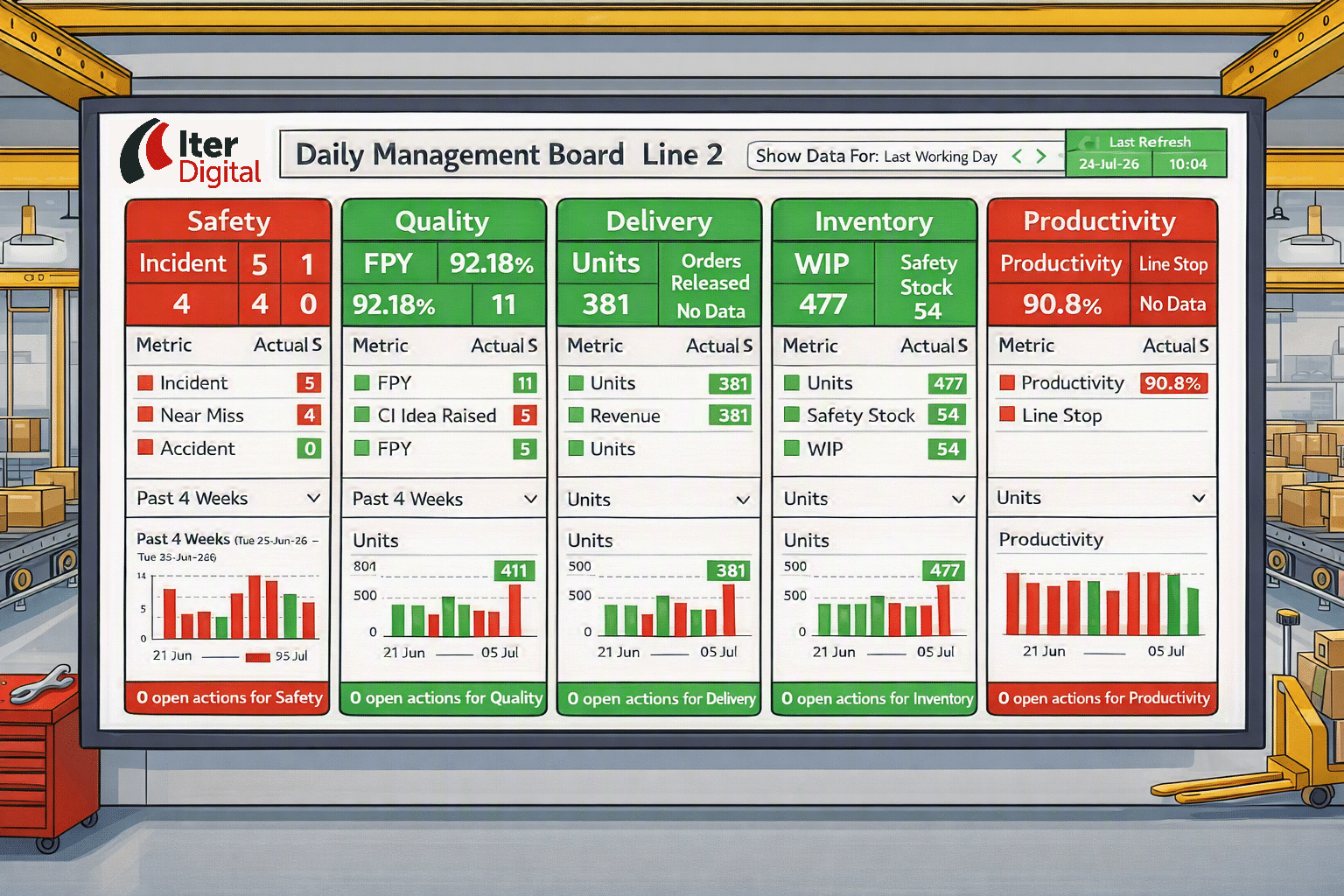
An SQDIP board is a visual management tool used by manufacturing teams to monitor key operational performance areas and support Daily Management activities. SQDIP typically represents:
Safety: Creating visibility of incidents, near misses, hazards and actions that support a safer working environment.
Quality: Monitoring defects, customer concerns, process performance and improvement activity.
Delivery: Understanding production output, schedule adherence and the ability to meet customer requirements.
Inventory: Tracking material availability, stock levels and the effective flow of materials through the operation.
People: Supporting workforce capability through visibility of skills, training, attendance and team development.
Different organisations may use variations such as SQDC, SQCDP or SQCDME, but the principle remains the same, make important information visible so teams can make better decisions.
The purpose of an SQDIP board is not simply to display whether performance is green or red. Its purpose is to create meaningful conversations.
How SQDIP Boards Support Effective Daily Management
A good SQDIP board provides teams with a shared understanding of current performance. For example, if delivery performance begins to fall below expectation, the board provides an immediate signal that something requires attention.
The Daily Management process then ensures the team asks:
- What has changed?
- What caused the issue?
- What impact does it have?
- What action is needed?
- Who owns the next step?
- Does this require further investigation?
The visual signal identifies the opportunity.
The conversation creates the response.
This is where Daily Management becomes more than performance reporting.
It becomes a mechanism for improvement.
What Does Good Daily Management Look Like?
While every manufacturing organisation will adapt its approach to suit its own environment, successful Daily Management systems usually share several characteristics.
1. Performance Information Is Clear and Relevant
The most effective Daily Management systems focus on measures that genuinely help teams make decisions. A KPI should not exist simply because it has always been reported.
Good measures are:
- Relevant to the people using them.
- Clearly understood.
- Updated consistently.
- Linked to operational priorities.
- Owned by the right people.
The purpose of measurement is not to create more data.
It is to create better decisions.
2. Daily Meetings Are Short, Structured and Focused
Effective Daily Management meetings are designed to create alignment without taking people away from value-added activities unnecessarily. Many organisations use short daily reviews to:
- Understand current performance.
- Highlight abnormalities.
- Agree priorities.
- Assign actions.
- Escalate issues when required.
The objective is not to solve every problem during the meeting.
Complex issues may require structured problem-solving methods such as:
- 3C Problem Solving.
- PDCA.
- A3.
- 8D.
The Daily Management process identifies the problem.
Structured Problem Solving creates the sustainable improvement.
3. Actions Have Clear Ownership
One of the biggest challenges with traditional visual management is ensuring actions are completed. A problem appearing on today’s board but remaining unresolved tomorrow quickly reduces confidence in the process. Effective Daily Management ensures actions have:
- A clear owner.
- A defined next step.
- A realistic timeframe.
- Regular follow-up.
Accountability is not about assigning blame.
It is about ensuring improvements happen
4. Leaders Support the Process
Daily Management is most effective when leaders actively participate. This means moving beyond simply reviewing numbers and instead focusing on:
- Asking questions.
- Understanding barriers.
- Supporting teams.
- Coaching problem solving.
- Removing obstacles.
This links closely with Leader Standard Work, where leaders establish consistent routines that reinforce Lean behaviours and support continuous improvement.
When Every SQDIP Metric Is Green, Should You Be Celebrating?
A completely green SQDIP board looks impressive.
Safety ✅
Quality ✅
Delivery ✅
Inventory ✅
People ✅
And sometimes it represents exactly what it appears to be:
- A stable operation.
- Strong processes.
- Effective leadership.
- Engaged teams.
However, experienced Lean organisations understand that colour alone does not tell the whole story. The important question is not:
“Are all our indicators green?”
The important question is:
“Does our performance board accurately reflect reality?”
A healthy Lean culture is not one where problems never appear.
It is one where problems become visible quickly and are addressed effectively.
Why Red Is Not Failure in a Lean Culture
Lean Manufacturing is built around continuous improvement.
Continuous improvement requires visibility of opportunities.
A red indicator is not automatically a sign of poor performance.
It is information.
It tells the team that something has changed.
The response should not be:
“Who caused this?”
The response should be:
- What happened?
- Why did it happen?
- What can we learn?
- What action is required?
- How do we prevent it happening again?
When teams feel comfortable raising issues early, organisations are better positioned to improve. The best-performing manufacturers are not those without problems. They are those that are best at identifying and solving them.
Moving From Reporting Yesterday to Managing Today
A common challenge with traditional performance reporting is that it can become focused entirely on historical results. Understanding yesterday matters. But Daily Management should also help teams manage today. Forward-looking discussions may include:
- Are we prepared to meet today’s production requirements?
- Do we have the right skills available?
- Are materials available when required?
- Are there equipment risks?
- Are customer priorities changing?
- Are any issues requiring leadership support?
This proactive approach helps organisations prevent problems rather than simply explain them afterwards.
Connecting Daily Management With Continuous Improvement
Daily Management creates the visibility needed to identify improvement opportunities. However, identifying a problem is only the beginning. The next step is understanding why it happened and preventing recurrence. This is where Daily Management connects with structured improvement activities.
A mature Lean Production System creates a clear pathway:
Identify the issue → Understand the cause → Take action → Sustain the improvement
Not every issue requires a detailed investigation. Some problems can be resolved quickly through immediate action. Others reveal recurring patterns that require deeper analysis. The important thing is ensuring problems are not repeatedly discussed without meaningful improvement taking place.
How Digital Daily Management Strengthens Lean Practices
Many manufacturers are now exploring how digital tools can support their Lean transformation journey. The objective should not be to digitise Lean simply because technology is available. It should be to make effective Lean practices easier to apply consistently.
A Digital Daily Management approach can help organisations:
- Improve visibility of operational performance.
- Reduce manual reporting activity.
- Provide consistent information across teams.
- Improve action tracking.
- Support faster escalation.
- Identify recurring trends.
- Connect daily issues with improvement activities.
A Digital Lean Production System can strengthen the connection between people, processes and performance by making information easier to access and act upon. However, technology is only an enabler.
The foundation remains strong Lean thinking, effective leadership and a culture of continuous improvement.
Building a Culture of Operational Excellence
Operational excellence is not achieved by creating a perfect dashboard. It is achieved by creating an environment where:
Performance is visible: Teams understand what is happening and where attention is needed.
Problems are discussed openly: Issues become opportunities to learn rather than something to hide.
Actions have clear ownership: Improvement activity moves forward.
People are empowered to improve: Everyone has a role in making processes better.
Daily Management provides the structure.
Lean principles provide the foundation.
People create the improvement.
The Future of Daily Management in Manufacturing
Manufacturing continues to evolve, but the principles behind effective Daily Management remain constant.
The tools may change.
The way information is captured may improve.
The technology supporting teams may develop.
But the purpose remains the same, to help people understand performance, solve problems and continuously improve.
At Iter Digital, we believe technology should strengthen Lean thinking, not replace it.
A Digital Lean Production System should make it easier for teams to see what is happening, respond faster and create better operational conversations. Because the goal of Daily Management is not to create a perfect-looking SQDIP board. The goal is to build a culture where problems are visible, improvements are measurable and teams are empowered to act.
Green is good.
But visibility, honesty and continuous improvement are better.
About the Author

Emma Bowler
Emma brings a unique blend of operational and technical experience, having worked across both manufacturing operations and IT. This combination gives her a practical understanding of the challenges organisations face when adopting digital solutions and driving continuous improvement.