
Jun 2 2026 | Insights | Emma Bowler
Digitising Leader Standard Work Without Losing the Human Connection
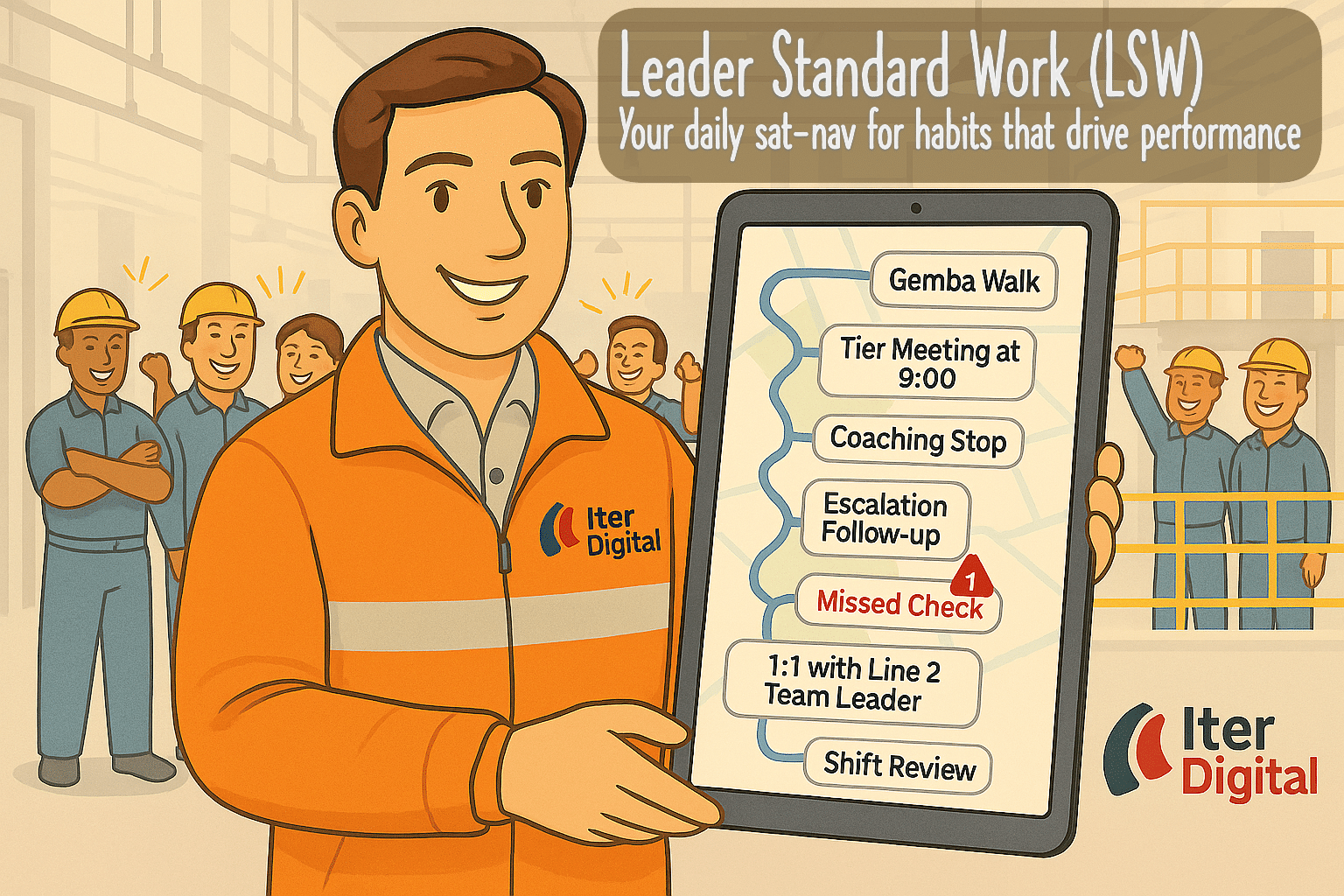
Leader Standard Work (LSW) is a cornerstone of Lean manufacturing. It provides a structured framework that ensures leaders consistently carry out the activities required to maintain performance, support teams, and drive continuous improvement. From Gemba walks and safety observations to coaching conversations and performance reviews, Leader Standard Work creates the discipline needed to sustain operational excellence.
Yet despite the importance of these activities, many organisations still rely on paper checklists, spreadsheets, whiteboards, and manual reporting processes to manage them. As operations become more complex and leaders face increasing demands on their time, these traditional methods can create unnecessary administrative burden and reduce visibility across the business.
The answer is not to replace leadership activities with technology.
The answer is to digitise the management of those activities while preserving the face-to-face interactions that make Leader Standard Work effective.
What is Leader Standard Work?
Leader Standard Work is a documented set of recurring activities that leaders perform on a daily, weekly, and monthly basis to support operational performance and reinforce Lean behaviours. Typical activities include:
- Gemba walks
- Safety observations
- Layered process audits
- Team performance reviews
- Coaching conversations
- Escalation meetings
- Improvement action reviews
- Reflection and learning reviews
- Compliance checks
These activities help leaders remain connected to their teams, understand operational challenges, identify improvement opportunities, and ensure standards are being maintained.
The value of Leader Standard Work comes from consistency. When leaders regularly engage with their teams and processes, problems are identified earlier, improvements are sustained, and accountability becomes embedded within the culture.
The Often Overlooked Importance of Reflection
One of the most valuable elements of Leader Standard Work is reflection.
Leaders spend significant time observing processes, reviewing performance, conducting audits, and supporting improvement activities. However, the true value of these activities is only realised when time is taken to reflect on what has been learned. Reflection allows leaders to:
- Identify recurring themes and trends
- Assess whether previous actions have been effective
- Understand the root causes behind persistent issues
- Recognise opportunities for improvement
- Share learning across teams and departments
Without reflection, organisations risk becoming focused on completing activities rather than learning from them. Reflection transforms observations into insights and insights into action.
The Challenge with Traditional LSW Management
While Leader Standard Work is widely recognised as a best practice, the way it is managed often creates its own challenges.
Many organisations still depend on:
- Paper-based audit sheets
- Manual sign-off processes
- Excel trackers
- Whiteboard schedules
- Email reminders
These approaches may seem simple, but they often result in hidden waste.
Limited Visibility
It can be difficult to see which activities have been completed, which are overdue, and where issues are emerging.
Increased Administration
Leaders can spend valuable time updating spreadsheets, filing paperwork, and preparing reports rather than supporting operational teams.
Inconsistent Execution
Without clear scheduling and reminders, important activities may be missed during busy periods.
Poor Action Tracking
Issues identified during audits or observations can easily be forgotten, delayed, or lost within email chains and handwritten notes.
Delayed Decision-Making
When information is gathered manually, it often becomes available long after the activity has taken place.
The result is a process designed to improve operational performance becoming burdened by administration.
Keeping Leadership Activities Physical
A common misconception is that digital transformation means moving everything onto a screen.
For Leader Standard Work, this would be a mistake.
The Gemba walk should still happen on the shop floor.
The safety conversation should still happen face-to-face.
The audit should still involve physically observing the process.
The coaching discussion should still take place directly with the individual.
The reflection process should still involve leaders reviewing performance, discussing findings with their teams, and considering the most effective actions to take.
These activities create value because they involve direct engagement with people and processes.
Technology should not replace these interactions.
Instead, it should support them.
Where Digitalisation Delivers Real Value
The greatest opportunity lies in digitising the administration surrounding Leader Standard Work rather than the activities themselves.
Digital Scheduling
Recurring leadership activities can be automatically scheduled and assigned to the appropriate individuals.
Leaders receive reminders when activities are due, helping ensure consistency without relying on diaries or spreadsheets.
Real-Time Recording
Observations, findings, and notes can be recorded instantly while activities are being carried out.
This reduces paperwork and improves data accuracy.
Action Management
Issues identified during audits, Gemba walks, or safety observations can be converted immediately into actions with clear ownership and deadlines.
Centralised Visibility
Operational leaders gain a clear view of activity completion, outstanding actions, recurring issues, and overall compliance performance.
Improved Reflection
When observations and actions are digitally recorded, leaders have access to accurate historical information during reflection activities.
Rather than relying on memory or handwritten notes, they can review trends, assess progress, and make more informed decisions.
The Benefits of Digitised Leader Standard Work
Organisations that digitise the management of Leader Standard Work often experience significant benefits.
Greater Accountability
Every activity, observation, and action has a clear owner and completion record.
Reduced Administration
Less time is spent updating paperwork and preparing reports, allowing leaders to focus on supporting their teams.
Improved Compliance
Scheduled activities are less likely to be missed, and records are automatically maintained for audit purposes.
Faster Problem Resolution
Issues can be identified, assigned, and tracked to completion more effectively.
Better Decision-Making
Real-time visibility provides leaders with the information they need to respond quickly and effectively.
Stronger Continuous Improvement
Consistent execution combined with accurate data creates a powerful foundation for sustainable improvement.
Supporting Leaders, Not Replacing Them
Digitalisation should never be viewed as a replacement for leadership.
The most effective leaders are visible, engaged, and present where the work happens. They build relationships, coach their teams, solve problems, and create a culture of continuous improvement.
Technology cannot replace these behaviours.
What it can do is remove the administrative burden that prevents leaders from spending more time on the activities that truly add value.
By digitising scheduling, recording, action management, escalation, and reporting, organisations can strengthen their Leader Standard Work processes while maintaining the human connection at the heart of Lean leadership.
How Iter Digital Supports Leader Standard Work
At Iter Digital, we help manufacturers modernise the way Leader Standard Work is managed without changing the behaviours that make it successful.
Our solutions digitise the planning, scheduling, recording, action tracking, escalation, and reporting of leadership activities, while ensuring that Gemba walks, audits, coaching conversations, safety observations, and reflection sessions continue to take place where they belong: alongside the people and processes that drive operational performance.
The result is improved visibility, stronger accountability, reduced administration, and more time for leaders to focus on continuous improvement.
Because the future of Leader Standard Work is not about replacing leadership with technology.
It’s about using technology to make leadership more effective.
About the Author

Emma Bowler
Emma brings a unique blend of operational and technical experience, having worked across both manufacturing operations and IT. This combination gives her a practical understanding of the challenges organisations face when adopting digital solutions and driving continuous improvement.