
Apr 22 2026 | Insights | Emma Bowler
Digitising Skills Matrices and Manning Boards: Unlocking Workforce Efficiency in Manufacturing
In manufacturing, people are your most valuable and most variable resource. Machines are largely predictable. Processes can be defined. But workforce capability, availability, and allocation are constantly changing. To manage this, many organisations rely on two familiar tools:
- Skills Matrices
- Manning Boards
On paper, these are powerful. In practice, they often fall short.
The Problem with Traditional Approaches
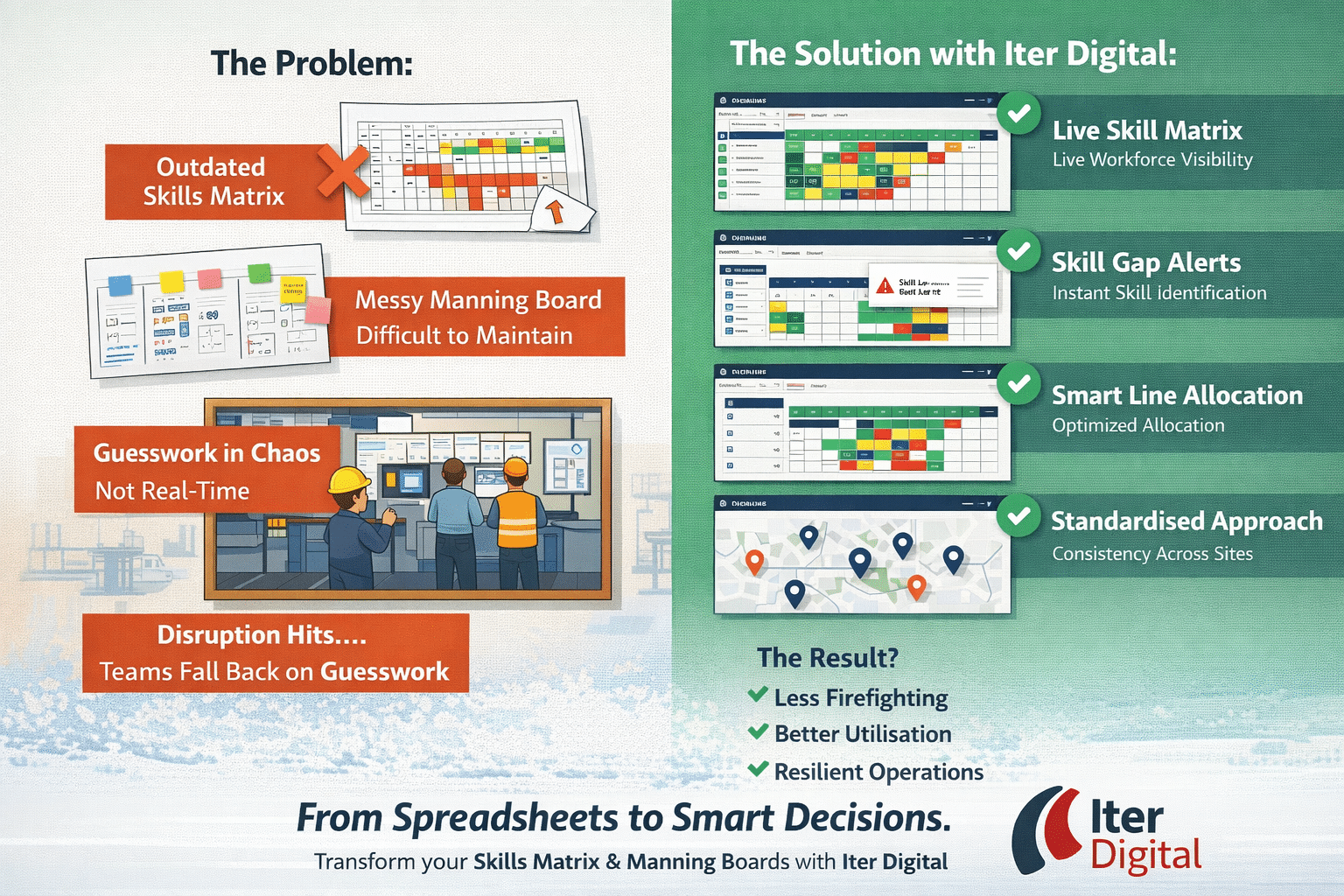
Walk into most factories and you’ll find a Skills Matrix displayed on a wall or stored in a spreadsheet. Manning Boards may sit nearby, used during shift planning or daily meetings. But scratch beneath the surface, and common challenges emerge:
Skills Matrices:
- Quickly become outdated
- Require manual updates
- Lack consistency across teams
- Provide limited visibility beyond a snapshot in time
Manning Boards:
- Built on static or incomplete data
- Rely heavily on supervisor experience
- Struggle to adapt to real-time changes
- Often disconnected from actual workforce capability
The result?
Decisions about who goes where – and whether production targets can be met – are often based on assumptions rather than facts.
Why This Matters More Than Ever
In today’s environment, variability is increasing:
- Absenteeism and labour shortages
- Demand fluctuations
- Greater product complexity
- Pressure to improve productivity without increasing headcount
Without accurate, real-time visibility of skills and availability, even the best-run operations are forced into reactive decision-making.
This leads to:
- Bottlenecks on critical processes
- Underutilisation of skilled operators
- Missed opportunities for cross-training
- Increased reliance on “hero” individuals
Moving from Static Tools to Dynamic Systems
Digitising Skills Matrices and Manning Boards transforms them from static references into live operational tools. Instead of asking, “What did the Skills Matrix say last week?”, teams can answer:
- Who is available right now?
- What are they trained and competent to do?
- Where are the current gaps?
- How do we optimise today’s plan based on reality?
What Digitisation Looks Like in Practice
1. Real-Time Skills Visibility
Skills data is continuously updated and accessible, providing an accurate view of workforce capability at any moment.
2. Smarter Manning Decisions
Supervisors can allocate people based on live data – balancing skill levels, demand, and constraints.
3. Immediate Gap Identification
Skill shortages are highlighted instantly, allowing proactive adjustments rather than reactive fixes.
4. Standardisation Across Operations
A consistent approach to workforce planning is applied across shifts, lines, and sites.
5. Data-Driven Workforce Development
Training and cross-skilling are guided by actual operational needs, not assumptions.
From Firefighting to Control
One of the biggest shifts we see when organisations digitise these tools is a move away from daily firefighting. Instead of scrambling to cover gaps, teams operate with:
- Greater confidence in their plans
- Faster response to disruption
- Improved communication across functions
- Clear accountability for decisions
This doesn’t just improve efficiency – it improves culture.
Operators feel better utilised.
Supervisors feel more in control.
And continuous improvement becomes part of daily operations, not a separate activity.
A Practical Example
Consider a production line experiencing frequent delays due to a shortage of trained operators on a critical process. In a traditional setup:
- The issue may only become visible once output drops
- Supervisors rely on memory or outdated matrices
- Short-term fixes are applied without addressing root causes
With a digitised system:
- The skill gap is visible before the shift begins
- Manning decisions are adjusted proactively
- Training needs are clearly identified and tracked
- The issue is resolved systematically, not repeatedly
The Iter Digital Approach
At Iter Digital, we focus on making Lean tools work in the real world – at scale, in real time. Our approach to digitising Skills Matrices and Manning Boards is built on three principles:
1. Simplicity
Systems must be easy to use on the shop floor, not just powerful in theory.
2. Relevance
Data must reflect real operational needs – not generic templates.
3. Actionability
Every piece of information should support better decision-making.
The Result: A More Resilient Workforce
When Skills Matrices and Manning Boards are fully digitised and connected, manufacturers gain:
- Better utilisation of their workforce
- Increased flexibility and responsiveness
- Reduced dependency on individual knowledge
- Stronger foundations for continuous improvement
Most importantly, they gain control.
Final Thought
Skills Matrices and Manning Boards were never meant to be static documents. They were designed to enable better decisions. Digitisation brings them back to life – turning them into real-time tools that help manufacturers put the right people in the right place, at the right time.
At Iter Digital, that’s exactly what we deliver with out Skill Matrix and Manning Board app.
About the Author

Emma Bowler
Emma brings a unique blend of operational and technical experience, having worked across both manufacturing operations and IT. This combination gives her a practical understanding of the challenges organisations face when adopting digital solutions and driving continuous improvement.