
Aug 24 2026 | Insights | Emma Bowler
Is Your Manufacturing Operation Digitised – or Just Digital?
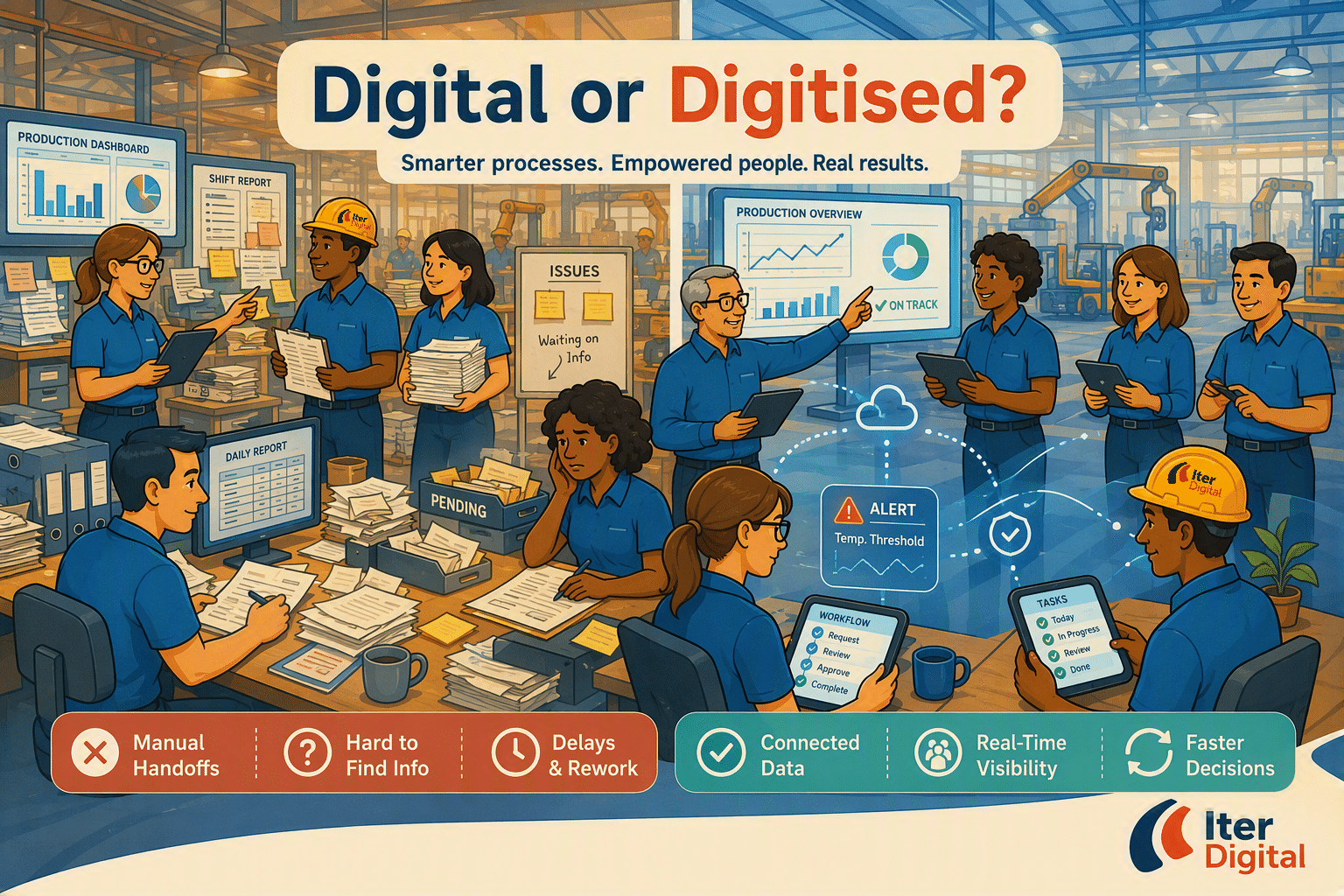
Manufacturing has spent years becoming more digital. Paper records have become electronic. Spreadsheets have moved into the cloud. Production information is displayed on screens. Systems have replaced forms. Data is available faster and in greater quantities than ever before. But perhaps we need to ask a more fundamental question:
Has manufacturing actually become more digitised – or have we simply put digital technology around largely unchanged ways of working?
It is an important distinction.
Because adding technology to a process is relatively straightforward. Changing the process itself is much harder. And that is where much of the real value of manufacturing digitalisation remains untapped.
The difference between digital and digitised
There is a subtle difference between the two.
Something is digital when information or an activity has been converted into a digital format.
Something is digitised when digital technology changes how that activity is performed.
That might sound like semantics, but the difference is significant.
Imagine a quality inspection that used to be recorded on paper. Moving the inspection onto a tablet makes it digital. But if the same information still has to be manually reviewed, copied into another system, discussed later and eventually turned into an action, very little has changed about the underlying process.
The record is digital.
The workflow is not.
True digitisation asks a bigger question:
What becomes possible because the process is now digital?
That is where manufacturers should be looking for value.
The danger of digital window dressing
There is a temptation in digital transformation to focus on what is visible.
A new dashboard.
A new application.
A new screen on the shop floor.
A new portal.
A new digital form.
These things make transformation tangible. But visible technology does not necessarily mean meaningful transformation. A digital dashboard might display exactly the same information that was previously written on a whiteboard. A digital form might collect exactly the same information as its paper predecessor. A cloud-based spreadsheet might still require five people to update it manually.
Everything looks modern.
But the underlying process remains essentially unchanged.
This is digital window dressing: technology is visible, but the way the organisation works has not fundamentally improved. The objective of digitalisation should be to change the latter.
What should actually change?
A useful way to think about digitalisation is to look at the journey information takes through an organisation.
- Where does information originate?
- Who needs it?
- What do they do with it?
- What decision does it support?
- What happens as a result?
- Who needs to know?
- What is recorded?
- What happens next?
In many manufacturing environments, that journey contains considerable friction.
Information is entered more than once.
People rely on email to move information between processes.
Teams maintain their own versions of the truth.
Managers spend time compiling information before they can use it.
Important decisions are made in meetings but poorly connected to what happens afterwards.
Knowledge remains with individuals rather than within the process.
These are not necessarily technology problems. They are information-flow problems. And digitalisation provides an opportunity to redesign that flow.
The real measure is not data – it is friction
Manufacturers often talk about digital transformation in terms of data.
- How much can we collect?
- How quickly can we access it?
- How many systems can we connect?
- How much information can we analyse?
But there is another measure that deserves more attention: How much friction can we remove from the way people work?
Think about the small frustrations that exist within almost every manufacturing organisation.
Someone has to find the latest document.
Someone has to combine several reports.
Someone has to chase an update.
Someone has to copy information from one system into another.
Someone has to prepare information for a meeting.
Someone knows where the answer is, but that knowledge is not readily available elsewhere.
Individually, these activities seem insignificant. Collectively, they represent a substantial amount of organisational effort. A successful digitalisation project should not simply create more information. It should remove some of this friction.
The best digitalisation is often invisible
There is an interesting paradox here. The most successful digital processes may be the ones people notice least. If a process works well, people do not think about the technology behind it.
Information is available when it is needed.
The right person sees it.
The next step is clear.
Duplication is removed.
Progress is visible.
Records are accessible.
Nobody needs to ask where the latest version is.
Nobody needs to spend an hour preparing information that the system already knows.
That is what good digitalisation should feel like. Not another system to manage. Less management of the system, more management of the operation.
Digitalisation should change the economics of work
This also changes how manufacturers should evaluate digital projects. A business case based purely on software cost and licence savings can miss a much larger opportunity. Consider the cost of administrative activity across an organisation. If ten people spend thirty minutes each week consolidating information, that may not look significant.
Multiply it across departments.
Across sites.
Across months.
Then consider the opportunity cost.
What could those people have been doing instead?
- Solving problems?
- Improving processes?
- Coaching teams?
- Developing capability?
- Supporting customers?
- Working on new products?
The value of digitalisation is often found in these recovered hours rather than in the technology itself. The question therefore becomes:
How much valuable human time can the process give back?
Digitalisation should also make organisations less dependent on individuals
Another characteristic of a mature digital process is that it reduces reliance on individual memory. Manufacturing organisations contain enormous amounts of practical knowledge.
Experienced employees know how things work.
They know where information is kept.
They know who needs to be contacted.
They know which report to look at.
They know what normally happens next.
This works – until someone is absent, changes role or leaves the organisation.
A well-designed digital process can make more of that knowledge part of the process itself. Not by trying to replace experience, but by making the surrounding workflow clearer and more accessible. That creates greater consistency. It also makes organisations more resilient.
But digitisation should not mean digitising everything
There is an important balance to maintain. Digitalisation is not automatically better than a physical process.
A paper note may be perfectly adequate.
A face-to-face conversation may be essential.
A visual board may be more effective than a screen for a particular team.
The goal is not to eliminate physical activity.
The goal is to identify where digital technology genuinely improves the outcome.
A good question is therefore not:
“Can we digitise this?”
It is:
“What problem would digitising this solve?”
If the answer is unclear, there may be no reason to do it.
If the answer is that it will remove duplication, improve visibility, reduce delays, preserve knowledge or make decisions easier, then there may be a compelling case.
What does a genuinely digitised operation look like?
There is no single definition. A highly digitised factory does not necessarily have the most screens or the greatest number of software applications. Instead, you would expect to see some common characteristics.
- Information moves with the process: People do not have to repeatedly recreate or transfer information simply to move work forward.
- People can access what they need: Information is available to the people who need it, when they need it, without unnecessary searching.
- Processes are consistent: The organisation is less dependent on individual workarounds and personal systems.
- Decisions are better supported: Digital information is connected to the activities and decisions it is intended to support.
- Administration is reduced: People spend less time maintaining information and more time acting on it.
- Knowledge is retained: Important information does not disappear when the person who knows it is unavailable.
- Improvement becomes easier: The organisation can learn from what it has already recorded rather than repeatedly starting from scratch.
Where does Iter Digital fit?
This is the space in which Iter Digital operates. Rather than approaching digitalisation as a technology replacement exercise, Iter Digital focuses on the operational processes that often sit between people, systems and day-to-day manufacturing activity. Its Digital Lean Production System is designed to help manufacturers turn processes that have traditionally relied on disconnected tools, manual administration and individual knowledge into structured digital workflows.
The strength of this approach is not simply putting an existing process onto a screen. It is the opportunity to make the process itself more consistent, visible and easier to manage.
Because the best digital solution is not necessarily the one with the most functionality.
It is the one that solves a real operational problem without creating another one.
A better question for the next digitalisation project
Perhaps the biggest shift manufacturers can make is to stop starting with technology. Instead of asking:
“What system should we buy?”
start with:
“Where is the way we work creating unnecessary friction?”
- Where are people duplicating effort?
- Where is information being lost?
- Where are decisions delayed?
- Where is knowledge trapped in individuals?
- Where are teams creating their own workarounds?
- Where are managers spending time managing information instead of managing the operation?
- Where could a better digital process make a measurable difference?
Those questions lead to much more valuable conversations.
They also make digital transformation considerably less about technology and considerably more about improving the business.
From being digital to becoming digitised
Manufacturing does not need more digital technology simply for the sake of becoming more digital. It needs technology that changes what is possible.
Technology that removes unnecessary work.
Technology that makes processes easier to follow.
Technology that makes information useful rather than simply available.
Technology that helps organisations become less dependent on manual administration and individual workarounds.
Technology that improves the way people work.
That is the difference between being digital and being digitised.
And as manufacturers consider the next stage of their digital transformation, that may be the more important question to ask.
Not “How digital are we?”
But “What has actually become better because we are digital?”
About the Author

Emma Bowler
Emma brings a unique blend of operational and technical experience, having worked across both manufacturing operations and IT. This combination gives her a practical understanding of the challenges organisations face when adopting digital solutions and driving continuous improvement.