
Sep 4 2026 | Insights | Emma Bowler
Stop Treating Your Skills Matrix Like an Audit Document
For many manufacturers, the Skills Matrix only becomes important when someone asks to see it. An auditor wants evidence of competence. A customer needs reassurance that operators are appropriately trained. A manager needs to identify a training gap. Someone opens the spreadsheet, checks the information and confirms that the records are up to date.
Then it goes back to being just that: a record.
But if your Skills Matrix is only being used to demonstrate what people can do, rather than helping you decide what they should be doing, you could be overlooking one of its most valuable roles. A Skills Matrix should support compliance. It should help identify training requirements. It should provide a clear record of capability and competence.
But it can do much more than satisfy an auditor.
It can help you run the operation.
A record of capability is not the same as an operational tool
Most Skills Matrices answer an important question: Who is trained or competent to do what?
That information matters. But knowing the answer and being able to use it when making operational decisions are two very different things.
Consider a typical shift.
Someone calls in sick. Production priorities change. Demand increases in one area. A team member needs to be moved. A particular operation suddenly requires additional support.
How quickly can the person managing the shift answer questions such as:
- Who else is capable of covering that role?
- Which areas have sufficient flexibility?
- Where would moving someone create a capability gap?
- Are there any single points of failure on the shift?
- Does the team have the right combination of skills to support the production plan?
- Who is available and competent to move where they are needed?
The answers may all exist somewhere in the Skills Matrix. But if that information isn’t accessible and usable when those decisions are being made, its operational value is limited. A Skills Matrix should not simply tell you what capability exists within the business. It should help you understand what that capability means for today’s operation.
Capability is an operational issue
Skills and competency are often treated primarily as a training, HR or compliance responsibility. But capability has a direct impact on operational performance. The skills available on a shift can affect:
- Production flexibility
- Labour deployment
- Absence cover
- Capacity
- Quality
- Resilience
- Bottlenecks
- The ability to respond when plans change
A production plan might look achievable on paper based on headcount alone. But headcount does not tell the whole story. Ten people are not necessarily interchangeable with ten other people. The capability of those individuals – and where that capability can be applied – can make the difference between a well-covered operation and one that is vulnerable to disruption. This is why workforce capability should not sit separately from operational decision-making.
It is part of it.
The spreadsheet isn’t necessarily the problem
It is tempting to say that the answer is simply to replace spreadsheets. But spreadsheets themselves aren’t always the problem. A well-maintained spreadsheet can contain accurate, valuable information about the workforce. The problem is what happens to that information next.
If maintaining the Skills Matrix becomes the objective, rather than using the information within it, the process can become disconnected from the operation it is supposed to support.
- Teams spend time updating records.
- Managers review competency levels.
- Training gaps are identified.
- Audit evidence is available.
All useful activities. But the question that is often missed is:
What decisions are we making differently because we have this information?
That is where the value of workforce capability data starts to change.
From recording skills to supporting decisions
A Skills Matrix becomes much more valuable when it is treated as a live source of operational information rather than a document that is reviewed periodically. Instead of simply recording whether someone has been trained or assessed, capability information can help leaders understand the strength and flexibility of the workforce at any given point.
That changes the conversation.
Instead of asking:
Are our Skills Matrix records up to date?Teams can start asking:
Do we have the capability we need today?
Instead of reviewing training gaps only as an administrative exercise, leaders can understand where those gaps create operational risk. Instead of discovering that a critical process depends on one person after they are absent, teams can identify single points of failure and develop capability before they become a problem. And instead of allocating people based primarily on availability, managers can make better-informed decisions based on both availability and competency.
Knowing is useful. Acting is where the value is.
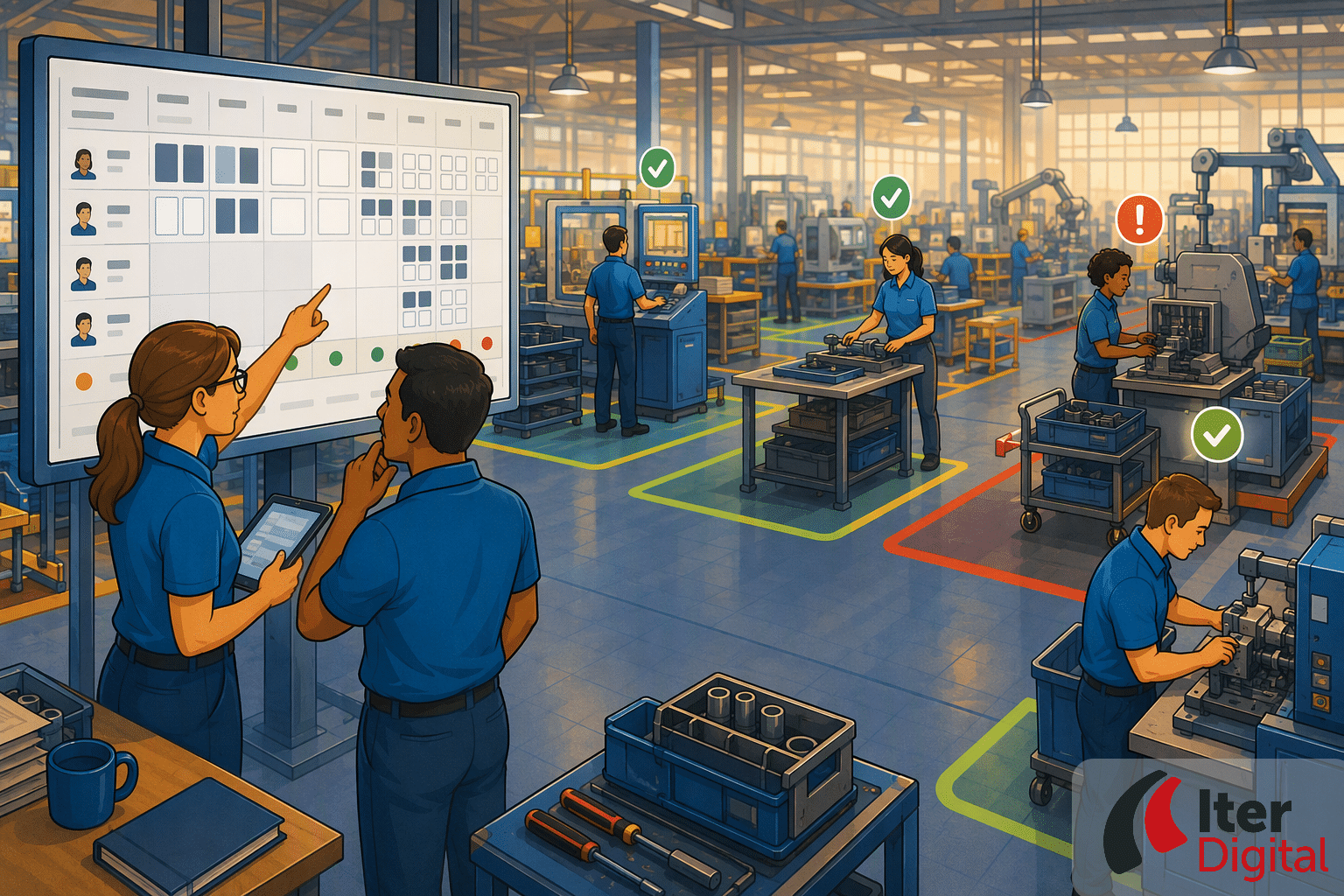
This is where the relationship between a Skills Matrix and a Manning Board becomes particularly important. A Skills Matrix provides the capability picture. A Manning Board helps turn that information into operational decisions. Together, they can help managers look beyond simply filling positions and start considering whether the right capability is available in the right areas.
When plans change, this matters.
When absence occurs, this matters.
When demand increases unexpectedly, this matters.
When a new product or process creates additional capability requirements, this matters.
The value is no longer limited to being able to prove who has completed training. The information becomes part of how the operation responds to the reality of the day.
The most useful Skills Matrix is the one that gets used
There is nothing wrong with using a Skills Matrix for audits. Manufacturers need reliable evidence of training and competence. They need to understand where capability gaps exist and ensure that people are appropriately qualified for the work they carry out. But that shouldn’t be the point at which the value of the Skills Matrix ends.
If the only time the information is actively used is when an auditor asks for it, there is an opportunity being missed. Your workforce capability is constantly influencing your operation. It influences where people can work, how flexibly teams can respond, where risk exists and how effectively the business can deal with change. The Skills Matrix should help make that visible. Because the real value isn’t simply knowing what your people can do. It’s using that knowledge to make better decisions about what happens next.
Making workforce capability part of the operation
At Iter Digital, our Skills Matrix and Manning Board application is designed to help manufacturers move beyond static competency records. By bringing workforce capability and operational deployment closer together, teams can gain a clearer view of available skills, identify potential gaps and use that information to support day-to-day manning decisions.
The result is not simply a better record for the next audit.
It is a more useful understanding of the capability available to run the operation today.
And that raises a question worth asking:
When was the last time your Skills Matrix changed a decision on the shop floor?
Skills Matrices: From Workforce Capability to Operational Decisions
What is a Skills Matrix used for in manufacturing?
A Skills Matrix is used to record and manage the skills, training and competency of employees. In manufacturing, it helps organisations understand who is qualified or competent to carry out specific tasks, operate particular equipment or work in different areas of the operation.
However, a Skills Matrix can also be used as an operational tool. When workforce capability information is accessible and kept up to date, it can help managers identify available skills, capability gaps and opportunities to deploy people more flexibly.
How can a Skills Matrix support operational decision-making?
A Skills Matrix can support operational decision-making by showing what capability is available across a team or shift.
Managers can use this information when responding to absence, changing production priorities, increased demand or resource constraints. Rather than making deployment decisions based on headcount or availability alone, they can consider whether people have the appropriate skills and competency for the roles that need to be covered.
What is the difference between a Skills Matrix and a Manning Board?
A Skills Matrix provides information about workforce capability, including the skills and competencies individuals have.
A Manning Board helps turn that information into operational decisions by supporting decisions about where people should be deployed.
Used together, they can help manufacturers understand not only who is available, but also who is capable of working where.
How can a Skills Matrix help identify workforce risks?
A Skills Matrix can help identify where critical capability is concentrated in too few people. This can reveal single points of failure, areas with limited flexibility and roles where absence could create operational disruption.
By making these risks visible, manufacturers can prioritise training and capability development before they become an operational problem.
How does a Skills Matrix support workforce flexibility?
Workforce flexibility depends on more than having enough people available. It depends on having the right combination of skills available when and where they are needed.
A Skills Matrix can help manufacturers understand where employees can work across multiple roles or areas, making it easier to respond when production priorities, staffing levels or demand change.
Can a Skills Matrix help identify training needs?
Yes. A Skills Matrix can help identify gaps between the capability currently available and the capability required to support the operation.
This allows manufacturers to prioritise training based not only on individual development requirements, but also on where additional capability would reduce operational risk and improve workforce flexibility.
About the Author

Emma Bowler
Emma brings a unique blend of operational and technical experience, having worked across both manufacturing operations and IT. This combination gives her a practical understanding of the challenges organisations face when adopting digital solutions and driving continuous improvement.