
Jun 17 2026 | Insights | Emma Bowler
The Role of Leadership in Digital Lean Transformation
Manufacturing organisations across the world are investing heavily in digital transformation initiatives. From real-time dashboards and digital daily management systems to connected shop floors and advanced analytics, the promise of improved visibility and operational performance is compelling.
Yet despite significant investment, many digital transformation projects fail to deliver the expected results.
The technology works. The data is available. The dashboards are live.
But six months later, performance has not improved as anticipated.
The reason is often surprisingly simple.
Digital transformation is not primarily a technology challenge. It is a leadership challenge.
The organisations that successfully transform their operations understand that technology is merely an enabler. Sustainable improvement comes from leadership behaviours, accountability and a culture that embraces continuous improvement.
Without these foundations, even the most sophisticated digital solution will struggle to create lasting value.
Why Technology Alone Doesn’t Deliver Results
There is a common misconception that introducing digital tools will automatically improve operational performance.
In reality, technology amplifies existing behaviours.
If an organisation already has strong leadership, clear accountability and effective problem-solving processes, digital tools can significantly enhance performance. However, if accountability is weak, standards are inconsistent and operational discipline is lacking, digitisation simply makes those problems more visible.
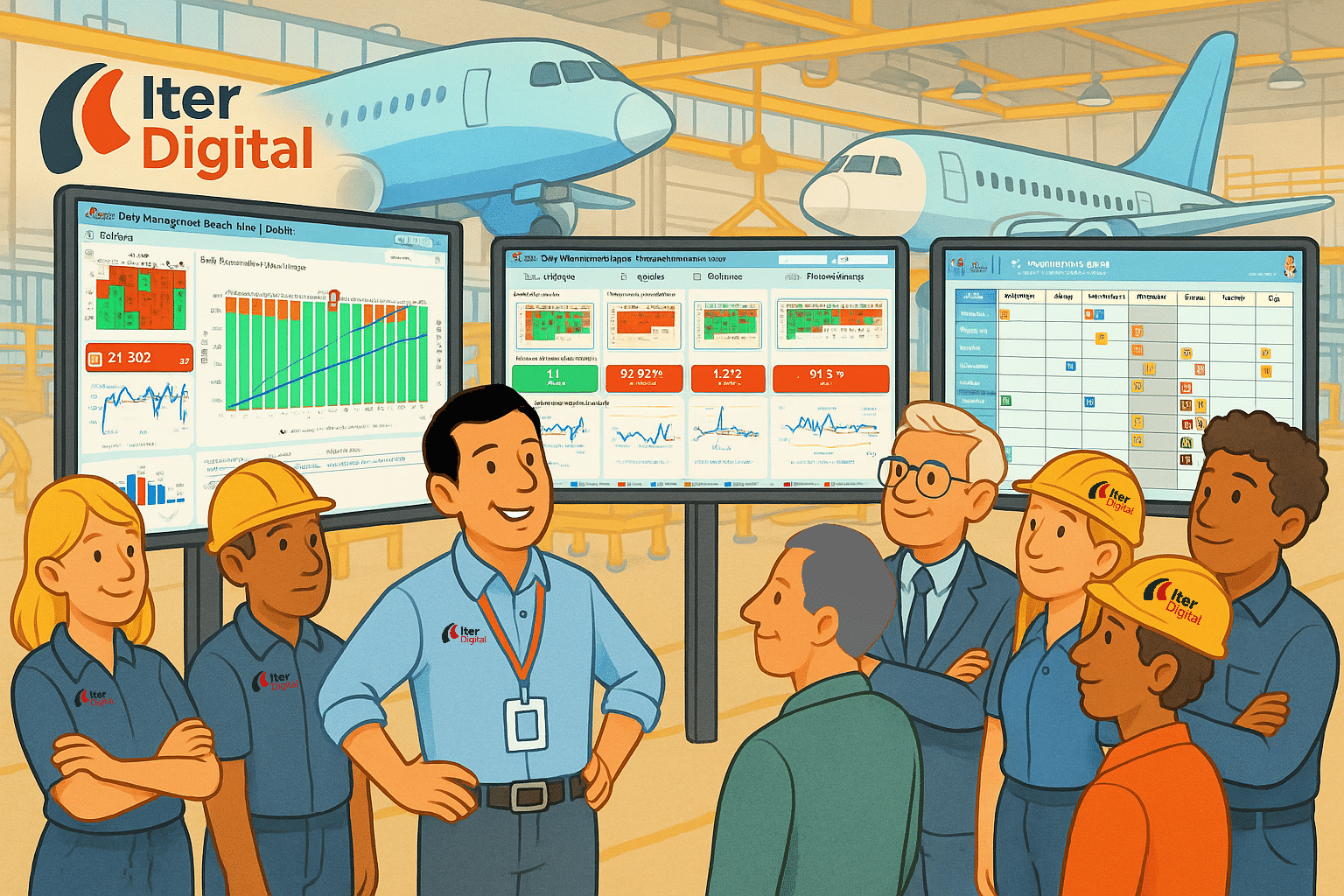
Consider a digital daily management board.
The technology may provide real-time visibility of performance metrics, actions and escalations.
However, if leaders fail to review the information, challenge performance gaps or support corrective actions, the system quickly becomes another screen on the wall.
The issue is not the technology.
The issue is how leadership engages with it.
The Difference Between Digitisation and Transformation
Many organisations use the terms digitisation and digital transformation interchangeably. They are not the same thing.
Digitisation involves replacing manual processes with digital alternatives. For example:
- Replacing whiteboards with digital boards.
- Moving audits from paper to tablets.
- Recording actions electronically rather than in spreadsheets.
These changes can improve efficiency and accessibility.
Digital transformation goes much further.
It changes how decisions are made, how teams collaborate and how leaders manage performance.
Transformation focuses on behaviours rather than technology.
This distinction is critical.
Many projects fail because organisations focus on implementing software instead of changing the behaviours required to support it.
Leadership Sets the Standard
Every successful Lean transformation begins with leadership. Employees quickly understand what is important within an organisation by observing leadership behaviour.
If leaders consistently review performance data, challenge issues and follow up on actions, teams recognise that operational discipline matters.
If leaders ignore dashboards, skip reviews and allow actions to drift, the opposite message is sent.
Digital systems provide visibility.
Leadership determines whether that visibility leads to action.
One of the most common observations during Lean transformation projects is that teams often mirror the behaviours demonstrated by their leaders.
When leaders actively engage with digital management systems, participation across the organisation increases significantly.
Creating Clear Expectations
Digital Lean systems are most effective when expectations are clearly defined. Leaders must establish:
- What metrics matter.
- How often performance should be reviewed.
- Escalation routes for unresolved issues.
- Ownership responsibilities.
- Standards for action completion.
Without clarity, digital tools can create confusion rather than improvement.
For example, a daily management board may display dozens of KPIs. If nobody understands which measures require immediate action, the board becomes a reporting mechanism rather than a management tool.
Strong leadership ensures that technology supports decision-making rather than simply presenting information.
The Importance of Visibility
Lean has always relied upon visibility.
Problems that cannot be seen cannot be solved.
Historically, visual management systems relied on physical boards located within production areas. While these remain valuable, modern manufacturing environments often require greater flexibility. Multiple production lines, multiple sites and hybrid working arrangements have increased the need for accessible, real-time information.
This is where digital Lean systems can provide significant advantages.
At Iter Digital, we regularly work with manufacturers who have outgrown traditional visual management approaches. Their teams spend valuable time updating whiteboards, compiling reports and consolidating spreadsheets. By digitising daily management and operational review processes, organisations can access performance information instantly, allowing leaders to spend more time improving performance and less time collecting data.
However, visibility alone is not enough.
Leaders must actively use the information available to them.
Supporting Problem Solving Rather Than Firefighting
One of the most valuable leadership responsibilities is creating an environment where teams solve problems effectively. Unfortunately, many manufacturing organisations become trapped in a cycle of firefighting.
Issues arise.
Immediate actions are taken.
The crisis passes.
The underlying cause remains.
The same issue eventually returns.
Digital systems can help identify recurring issues and track corrective actions, but leaders must encourage structured problem-solving behaviours. This includes:
- Challenging assumptions.
- Asking effective questions.
- Encouraging root cause analysis.
- Reviewing action effectiveness.
- Recognising learning opportunities.
Leaders who focus solely on short-term results often reinforce reactive behaviour.
Leaders who invest in problem-solving capability create long-term performance improvements.
Sustaining Improvements Over Time
Many transformation programmes begin with enthusiasm.
New systems are introduced.
Training is completed.
Performance improves.
Then attention shifts elsewhere.
Standards begin to drift.
Reviews become inconsistent.
Actions remain open for longer periods.
Eventually, old habits return.
Sustainability is one of the greatest challenges facing manufacturing organisations. Technology can help maintain consistency, but leadership remains essential.
Leader Standard Work plays a critical role in sustaining improvement. By defining routine leadership activities, organisations create consistency in how performance is reviewed, issues are escalated and improvements are maintained. Digital Leader Standard Work solutions can further strengthen this process by providing visibility of completed activities, overdue actions and emerging risks.
Building a Culture of Accountability
Accountability is often misunderstood.
It is not about blame.
It is about ownership.
High-performing organisations create environments where individuals understand their responsibilities and have the support required to fulfil them.
Digital systems can significantly improve accountability by making actions, ownership and progress visible.
At Iter Digital, one of the most common outcomes reported by customers is improved action completion rates. When ownership becomes visible across teams and leadership levels, accountability naturally increases.
People are more likely to complete actions when expectations are clear and progress is transparent.
Technology enables this visibility.
Leadership reinforces it.
The Future of Digital Lean Leadership
As manufacturing continues to evolve, leadership responsibilities will become increasingly important.
Artificial intelligence, automation and advanced analytics will provide more information than ever before.
The challenge will not be obtaining data.
The challenge will be using it effectively.
Successful leaders will focus less on collecting information and more on interpreting it, coaching teams and driving improvement.
Technology will continue to evolve.
The principles of effective leadership will remain unchanged.
Conclusion
The success of digital Lean transformation is determined far less by software capability than by leadership capability.
Technology can improve visibility, standardise processes and support decision-making.
However, sustainable improvement only occurs when leaders actively engage with those systems and reinforce the behaviours required for success.
Manufacturers that achieve the greatest results combine strong Lean principles, clear accountability and effective digital tools.
At Iter Digital, we help organisations digitise Lean processes such as Daily Management, Structured Problem Solving, Leader Standard Work and Assessments. However, the most successful implementations are always those supported by engaged leadership teams who view technology as an enabler of continuous improvement rather than a replacement for it.
Digital transformation is not ultimately about software.
It is about creating better leaders, better decisions and better operational performance.
About the Author

Emma Bowler
Emma brings a unique blend of operational and technical experience, having worked across both manufacturing operations and IT. This combination gives her a practical understanding of the challenges organisations face when adopting digital solutions and driving continuous improvement.