
May 14 2026 | Insights | Emma Bowler
The True Cost-Benefit of a Digital Lean Production System: What Most Businesses Overlook
For many manufacturers, the idea of adopting a digital lean production system is still framed as a cost question: What will it take to implement, and how quickly will it pay back? That’s understandable. But it’s also incomplete.
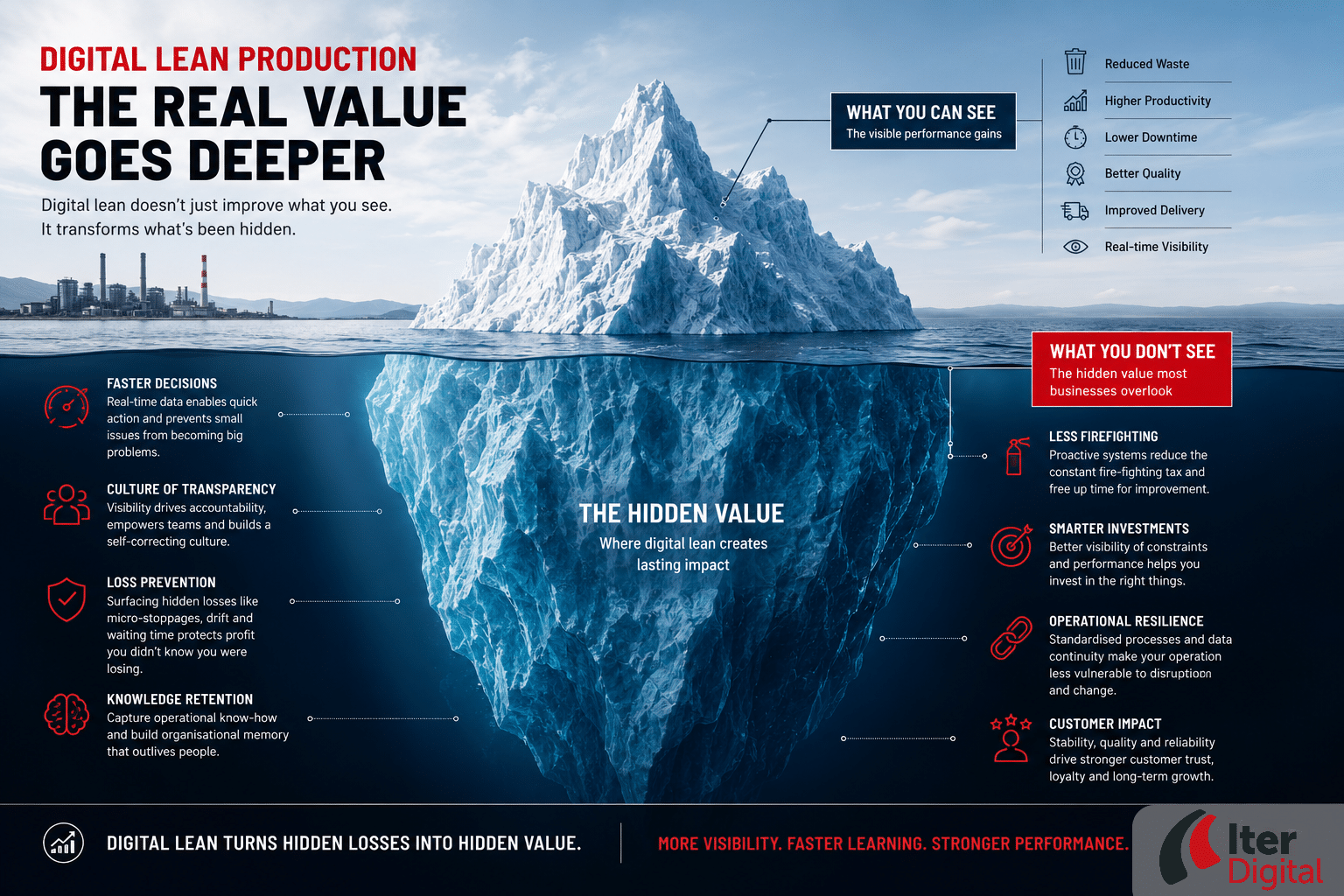
The real value of combining digital tools with Lean Manufacturing principles goes far beyond visible efficiency gains like reduced waste, faster cycle times, or improved throughput. The most significant benefits are often hidden – emerging gradually, and frequently overlooked in traditional ROI calculations.
Let’s unpack both the obvious and the less obvious value drivers.
The Visible ROI: What Most Companies Expect
When organisations adopt a digital lean production system, they typically expect improvements in:
- Reduced waste (materials, time, motion)
- Increased operational efficiency
- Better production scheduling and flow
- Reduced downtime through predictive maintenance
- Improved quality and fewer defects
- Enhanced visibility of KPIs in real time
These are real, measurable, and often achievable within months of implementation when systems are well deployed.
However, focusing only on these outcomes misses a much larger economic and strategic picture.
The Hidden Benefits: Where the Real Value Lives
1. Decision Speed (Not Just Decision Quality)
Most lean conversations focus on better decisions. Digital lean introduces something more powerful: faster decisions with acceptable accuracy.
When production data is live, visual, and contextual, supervisors and operators don’t wait for end-of-shift reports or weekly summaries. Problems are identified and acted upon in minutes rather than days.
This compression of decision cycles has a compounding effect:
- Small issues are resolved before becoming systemic failures
- Bottlenecks are removed before they impact downstream operations
- Teams spend less time analysing and more time improving
In practice, speed of response often delivers more financial value than marginal gains in optimisation accuracy.
2. Cultural Shift Through Transparency
One of the least quantified benefits of digital lean systems is behavioural change.
When performance data is visible in real time:
- Accountability becomes shared, not enforced
- Teams self-correct more quickly
- Problem ownership shifts closer to the point of work
This reduces the need for management escalation layers and creates a more autonomous workforce.
The hidden value? Reduced management overhead and fewer coordination failures, which rarely appear in ROI spreadsheets but significantly affect profitability.
3. Loss Prevention Over Efficiency Gains
Traditional lean focuses heavily on efficiency: doing more with less. Digital lean shifts emphasis toward preventing invisible losses, such as:
- Micro-stoppages that never get logged
- Slow degradation in machine performance
- Quality drift that only shows up in customer complaints
- Partial utilisation of skilled labour
- Unrecorded waiting time between process steps
These losses often accumulate silently and represent a far larger cost than obvious downtime events.
Digital systems surface these patterns early, turning “unknown unknowns” into actionable data.
4. Knowledge Retention and Operational Memory
In many manufacturing environments, critical knowledge lives in people’s heads – not systems.
When experienced operators retire or move roles, organisations often experience:
- Loss of tacit process knowledge
- Relearning curves for replacements
- Inconsistent production standards
A digital lean system captures operational patterns, deviations, and corrective actions over time. This creates a form of organisational memory, reducing dependency on individuals.
The hidden benefit here is resilience: production stability becomes less vulnerable to workforce turnover.
5. Reduced Firefighting Costs (The “Invisible Tax”)
Most factories underestimate how much time is spent in reactive mode:
- Expediting late orders
- Investigating defects after shipment
- Manually adjusting schedules
- Resolving avoidable breakdown escalations
This “firefighting tax” is rarely tracked as a line item, but it consumes significant leadership bandwidth.
Digital lean systems reduce this burden by:
- Highlighting issues earlier in the process
- Standardising escalation pathways
- Making root causes easier to identify
The result is more time spent on improvement rather than recovery.
6. Better Capital Allocation Decisions
One of the most overlooked benefits is improved investment clarity.
When production data is digitised and structured:
- Equipment ROI becomes easier to validate
- Bottleneck investments are clearly identifiable
- Underutilised assets are visible
- Expansion decisions are based on real constraint data, not assumptions
This prevents overinvestment in the wrong areas – arguably one of the most expensive hidden costs in manufacturing.
7. Customer Experience Stability
Lean is often framed as an internal efficiency model, but digital lean extends its impact outward.
By stabilising production variability, organisations achieve:
- More consistent delivery times
- Fewer last-minute order changes
- Improved product consistency
Customers rarely reward “efficiency” – but they do reward reliability. And reliability translates directly into retention and pricing power.
The Real Cost Equation
When evaluating digital lean, the mistake many organisations make is comparing:
Implementation cost vs. visible operational savings
A more accurate equation is:
Implementation cost vs. total system value (visible savings + hidden gains + avoided losses)
In many cases, the hidden components account for 40–70% of total value creation.
The Strategic Shift: From Efficiency to Intelligence
The real transformation is not just operational – it’s strategic.
A digital lean production system turns manufacturing from a reactive environment into a self-correcting system of continuous intelligence.
Instead of asking:
- “Where did we lose efficiency last month?”
Organisations begin asking:
- “What is changing right now, and what does it mean for tomorrow’s performance?”
That shift is where competitive advantage emerges.
Final Thought
Digital lean is often sold as an optimisation tool. In reality, its most powerful impact is not optimisation at all – it is visibility, speed, and organisational learning at scale.
The companies that win with it are not just the ones that reduce waste fastest, but the ones that learn faster than their competitors.
And in modern manufacturing, learning speed is the new efficiency.
About the Author

Emma Bowler
Emma brings a unique blend of operational and technical experience, having worked across both manufacturing operations and IT. This combination gives her a practical understanding of the challenges organisations face when adopting digital solutions and driving continuous improvement.