
Jul 17 2026 | Insights | Emma Bowler
What Makes a Digital Lean Production System Different from an MES?
As manufacturers continue to invest in digital transformation, many organisations are asking an important question:
“Do we need a Manufacturing Execution System (MES), or do we need a Digital Lean Production System?”
The answer depends on the challenge you are trying to solve. Because while both systems provide valuable operational insight, they support different aspects of manufacturing performance.
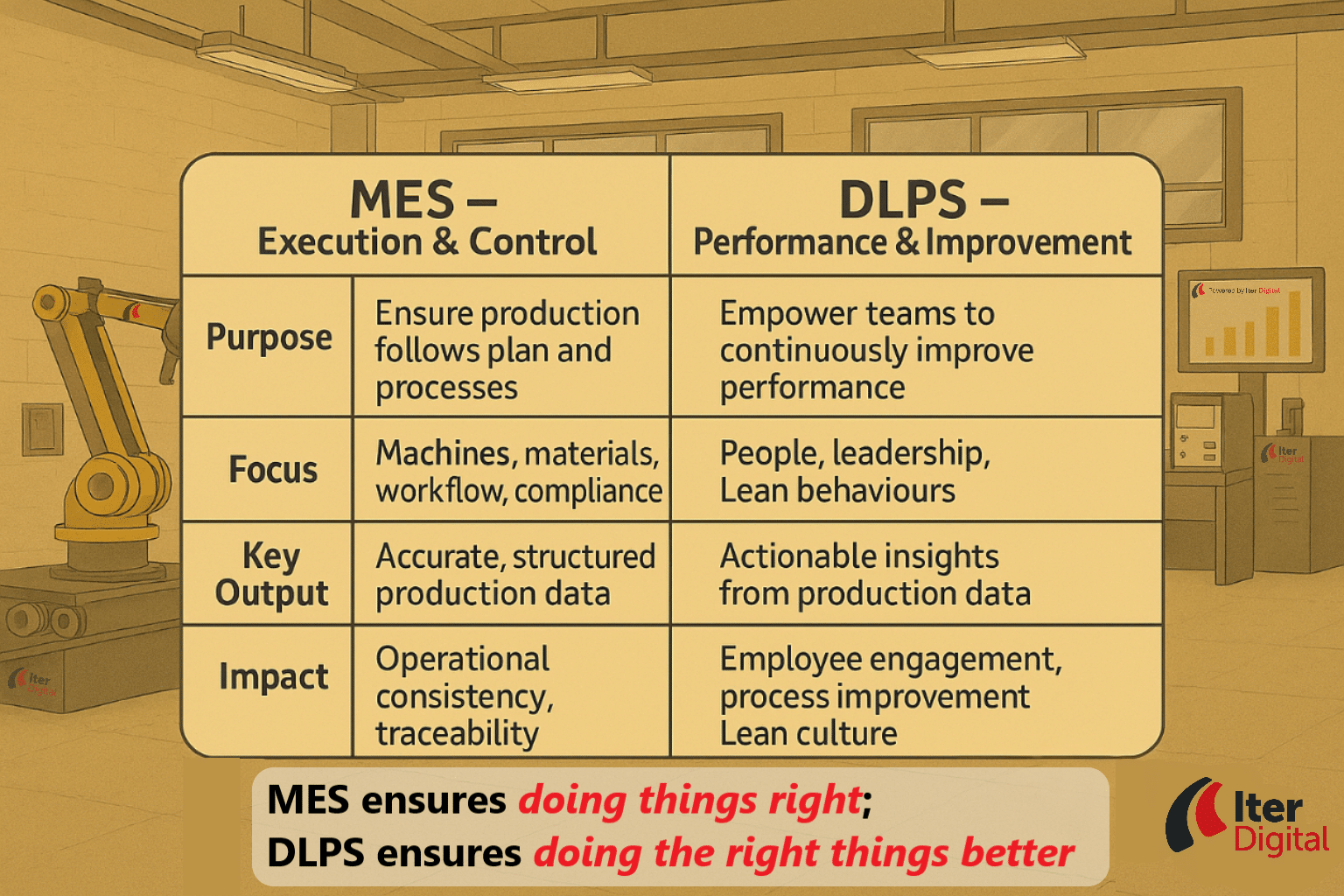
A MES is designed to help manage and control production execution.
A Digital Lean Production System (DLPS) is designed to help organisations understand performance, manage problems, drive accountability and continuously improve.
The difference is simple:
An MES tells you what happened.
A Digital Lean Production System helps you understand why it happened and what to do next.
What Does a MES Do?
A Manufacturing Execution System provides visibility of production activity by collecting and managing data from the manufacturing process. A MES helps answer questions such as:
- What product was produced?
- Which machine produced it?
- When did production start and finish?
- How much was produced?
- Was the correct process followed?
- What was the impact on production performance?
Typical MES functionality includes:
- Production tracking
- Work order management
- Product genealogy and traceability
- Quality data collection
- Production reporting
- OEE monitoring
- Electronic work instructions
- Machine and equipment data collection
For many manufacturers, these capabilities are essential. A MES provides valuable visibility into production performance and helps organisations understand what is happening on the shop floor. However, understanding what happened is only the beginning.
The Missing Question: Why Did It Happen?
Imagine a production line stops unexpectedly. Your MES may provide the following information:
- The machine stopped at 10:14
- The stoppage lasted 18 minutes
- Production output reduced by 145 parts
- OEE performance was impacted
- The affected production order and equipment were recorded
This information is important. But the biggest question remains:
Why did the machine stop?
Was it:
- A tooling issue?
- A material shortage?
- A quality concern?
- An incorrect process?
- A training gap?
- A recurring equipment failure?
- A standard not being followed?
Knowing the duration of a problem does not necessarily help prevent it happening again.
This is where a Digital Lean Production System adds value.
What Is a Digital Lean Production System?
A Digital Lean Production System (DLPS) supports the management processes, behaviours and improvement activities that enable operational excellence. It digitises the Lean systems that many manufacturers still manage through whiteboards, spreadsheets, paper forms and disconnected tools.
A DLPS helps organisations create visibility, structure and accountability around the activities that drive continuous improvement. This includes:
- Digital Daily Management
- SQDIP performance boards
- Action management
- Structured Problem Solving
- Leader Standard Work
- Skills Matrices
- Digital assessments
- Issue escalation workflows
However, the true value is not the individual applications.
The value comes from connecting them together into one continuous improvement system.
A Digital Lean Production System Goes Beyond Production Data
One of the biggest differences between an MES and a Digital Lean Production System is the scope of information being managed. Manufacturing performance is not only influenced by machines and production orders. People, processes, skills, safety and daily management routines all have a direct impact on operational performance. A DLPS helps leaders understand the complete picture.
People and Workforce Performance
A factory can have the best production systems in the world, but performance still depends on having the right people with the right skills available at the right time. A Digital Lean Production System can provide visibility of:
- Attendance trends
- Absence levels
- Skills availability
- Training requirements
- Competency levels
- Workforce flexibility
- Shift capability
- Manning requirements
For example, a production delay may appear to be an equipment issue. However, the underlying cause could be:
- A lack of trained operators
- Unexpected absence
- A skills gap
- Poor workforce allocation
A DLPS helps connect these operational factors to performance outcomes.
Safety Performance
Safety is a fundamental part of any effective Lean Production System. A Digital Lean Production System can support visibility and management of:
- Safety incidents
- Near misses
- Safety observations
- Corrective actions
- Safety improvement activities
- Audit findings
Safety issues should not sit separately from operational performance. By bringing safety activities into Daily Management and improvement processes, organisations create greater ownership and faster resolution.
Quality and Continuous Improvement
Quality issues are not just numbers on a report. They represent opportunities to improve the process. A Digital Lean Production System helps teams manage:
- Quality concerns
- Containment actions
- Corrective actions
- Root cause investigations
- Improvement activities
- Lessons learned
The focus moves from simply recording defects to understanding why they occurred and preventing recurrence.
From Problem Detection to Problem Prevention
Identified: A problem is raised immediately through a digital escalation process, ensuring visibility reaches the right people quickly.
Managed: The issue becomes part of the Daily Management process, where teams review performance, prioritise problems and assign ownership.
Investigated: If required, the issue is converted into a Structured Problem Solving activity using methods such as A3, PDCA or 8D.
Resolved: Actions are assigned, tracked and managed until completion, creating clear accountability.
Sustained: Leader Standard Work and operational reviews ensure improvements are maintained and lessons learned are embedded.
The result?
And it has a structured approach to reducing the likelihood of it happening again.
MES vs Digital Lean Production System: Understanding the Difference
|
Manufacturing Execution System (MES)
|
Digital Lean Production System (DLPS)
|
|
Production execution
|
Operational excellence
|
|
Machine and process data
|
People, process and performance data
|
|
Equipment performance
|
Workforce capability and operational readiness
|
|
Downtime measurement
|
Downtime improvement and prevention
|
|
Production traceability
|
Problem solving and prevention
|
|
Quality recording
|
Corrective action management
|
|
Production reporting
|
Daily Management and performance reviews
|
|
Manufacturing history
|
Organisational learning
|
|
Production events and outcomes
|
Root cause understanding and continuous improvement
|
|
Identifies what happened
|
Understands why it happened and what needs to happen next
|
|
Tracks production performance
|
Drives accountability and improvement actions
|
|
Provides visibility of issues
|
Provides structure to resolve and sustain improvements
|
|
Focuses on production processes
|
Connects production, people, leadership and improvement activities
|
|
Answers: “What happened?”
|
Answers: “Why did it happen, what are we doing about it, and how do we prevent recurrence?”
|
Why Manufacturers Need More Than Data
Most manufacturers do not suffer from a lack of information. The challenge is turning information into action.
A business can have dashboards showing downtime, quality losses and production performance, but without a structured approach to reviewing issues, assigning ownership and tracking improvements, the same problems can continue to repeat. A Digital Lean Production System helps close this gap by connecting:
Data → Visibility → Action → Improvement
It provides teams with the structure needed to move from reactive problem solving to proactive continuous improvement.
Does a Digital Lean Production System Replace an MES?
No.
A Digital Lean Production System is not designed to replace an MES. In many cases, the two systems work alongside each other.
A MES provides valuable production intelligence.
A DLPS helps organisations enrich and act on that intelligence.
Together, they provide a more complete approach:
- MES helps identify where performance issues exist.
- DLPS helps teams understand the causes behind those issues.
- MES provides production visibility.
- DLPS provides the management system to drive improvement.
The combination creates a stronger foundation for operational excellence.
Digital Transformation Should Be About Better Decisions
Successful digital transformation is not about collecting more data. Manufacturers already have huge amounts of data available. The challenge is making sure that data leads to better decisions, faster problem solving and sustainable improvement.
A Digital Lean Production System provides the connection between operational information and improvement activity. Because knowing that something went wrong is only the first step. The real value comes from understanding why it happened – and having the structure, accountability and processes in place to prevent it happening again.
An MES captures the event.
A Digital Lean Production System drives the response
About the Author

Emma Bowler
Emma brings a unique blend of operational and technical experience, having worked across both manufacturing operations and IT. This combination gives her a practical understanding of the challenges organisations face when adopting digital solutions and driving continuous improvement.