
Jul 29 2026 | Insights | Emma Bowler
What Should You Measure vs What Should You Record? Understanding the Difference in a Digital Lean Production System
Walk into almost any manufacturing facility and you’ll find dashboards full of numbers.
Safety.
Quality.
Delivery.
Productivity.
Attendance.
OEE.
Downtime.
The assumption is often that if data exists, it belongs on a dashboard.
But that’s rarely the case.
One of the biggest mistakes organisations make when digitising Lean is believing every piece of information should become a KPI. The result is dashboards overloaded with charts, meetings filled with numbers, and teams spending more time explaining performance than improving it.
A successful Digital Lean Production System takes a different approach.
It recognises that there is a significant difference between what you measure and what you record.
Understanding that difference helps create simpler processes, more meaningful dashboards and, ultimately, better decisions.
Measuring and Recording Serve Different Purposes
Although they’re closely linked, measuring and recording are not the same thing.
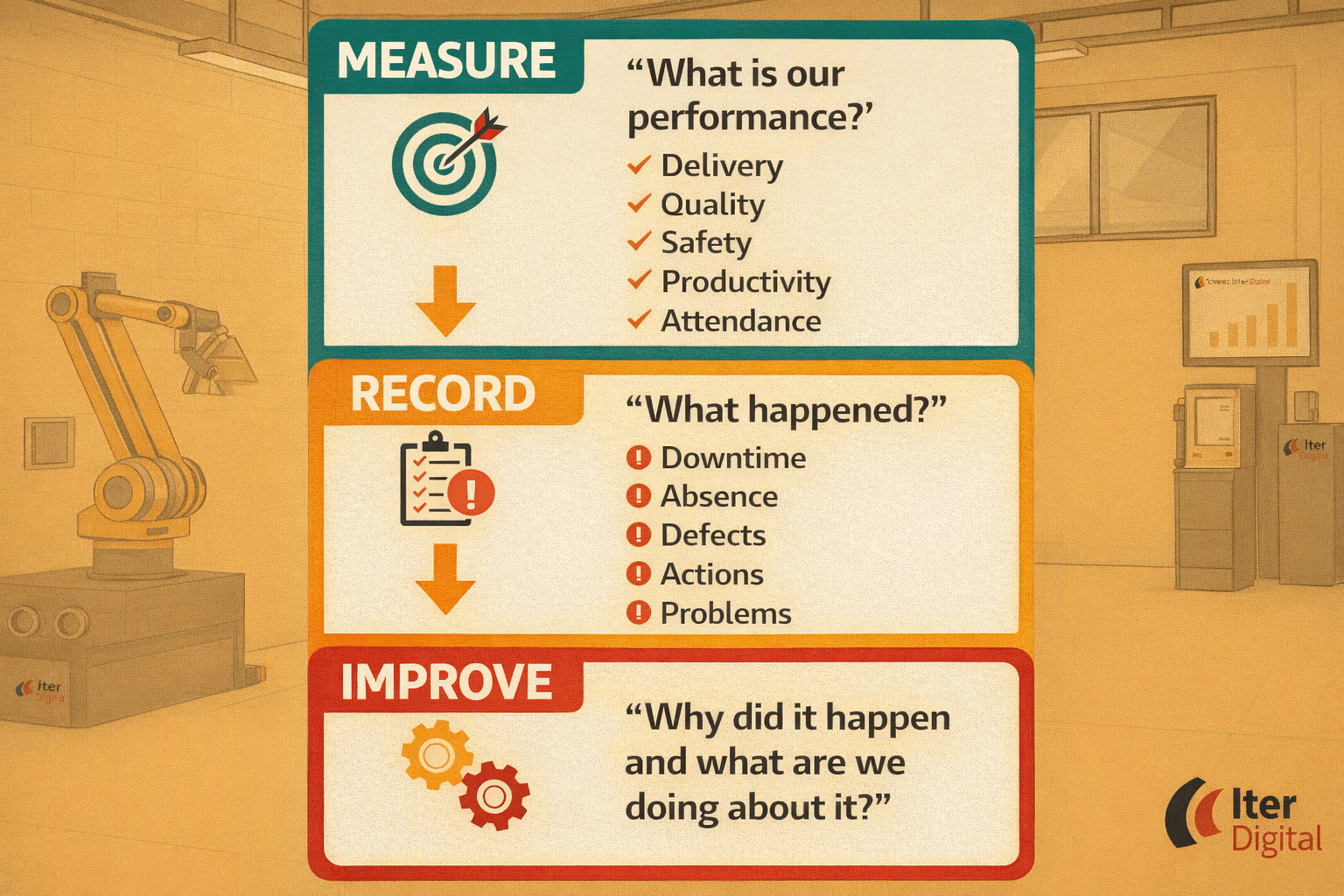
Measuring tells you how well you’re performing.
Recording captures what actually happened.
The two work together.
Without measurements, you don’t know whether you’re improving.
Without recorded operational data, you don’t know why performance has changed.
Think of it this way.
Your dashboard tells you that delivery performance has fallen.
Your operational records explain that the drop was caused by a supplier shortage, an equipment breakdown and a prolonged changeover.
The dashboard identifies the symptom.
The recorded information identifies the cause.
Both are essential.
What Should You Measure?
Performance measures should answer one simple question:
“How are we performing against our objectives?”
These are the indicators reviewed during Daily Management meetings, operational reviews and leadership discussions.
Good performance measures are:
- Aligned to business objectives
- Reviewed consistently
- Easy to understand
- Actionable
- Stable over time
Most manufacturers only need a relatively small number of core operational metrics.
Typical examples include:
- Safety performance
- Quality performance
- Delivery performance
- Productivity
- Cost
- Attendance
- Labour utilisation
- Overall Equipment Effectiveness (OEE)
- Right First Time
- Customer complaints
- Schedule adherence
- Inventory performance
These metrics provide visibility into how the business is performing.
But they rarely explain why.
What Should You Record?
Recording operational information serves a different purpose. Rather than measuring success, it captures the events, activities and exceptions that influence performance.
Examples include:
- Downtime events
- Machine faults
- Material shortages
- Quality defects
- Scrap and rework
- Near misses
- Safety observations
- Customer complaints
- Shift handovers
- Actions raised
- Actions completed
- Problem-solving activities
- Audit findings
- Skills assessments
- Training completed
- Leader Standard Work activities
- Improvement ideas
Some of this information may never appear directly on a dashboard. Yet it is often the most valuable data within the business because it provides the context needed to improve performance.
Sometimes You Don’t Record the Metric at All
One of the biggest misconceptions when designing a Digital Lean Production System is believing you need to capture the KPI itself. In reality, many performance measures are calculated from the operational events that sit behind them.
Take attendance as an example.
Very few organisations ask supervisors to record that every employee attended work today.
Instead, they record the exceptions.
Who’s absent?
Who’s off sick?
Who’s arrived late?
From those records, attendance can be calculated automatically.
The same principle applies throughout manufacturing.
|
If you want to measure…
|
You usually record…
|
| Attendance | Absence, sickness and lateness |
| Delivery Performance | Late orders, missed schedules and delivery constraints |
| Quality | Defects, scrap, rework and customer complaints |
| Safety | Accidents, near misses, hazards and unsafe observations |
| Equipment Availability | Downtime events, breakdowns and planned maintenance |
| Productivity | Production quantities, downtime and labour hours |
| Skills Coverage | Competency assessments and training completed |
| Action Completion | Actions raised, completed and overdue |
| Continuous Improvement | Improvement ideas, corrective actions and problem-solving activities |
| Leader Standard Work Compliance | Completed and missed leadership activities |
This is an important distinction.
Operational teams don’t spend their day entering KPIs.
They record what actually happened.
The Digital Lean Production System then transforms those operational records into meaningful performance measures, trends and dashboards automatically. This reduces administration, improves accuracy and ensures every KPI is backed by real operational evidence.
A Practical Example
Imagine your Daily Management dashboard shows:
- Delivery performance has dropped to 91%
- Downtime has increased by 18%
- Productivity is below target
Those numbers immediately tell you something needs attention.
But they don’t tell you why.
Now imagine your operational records show:
- Three material shortages
- Two unplanned machine breakdowns
- One extended tooling change
- Four quality defects requiring rework
- Two operator absences
Suddenly the picture becomes much clearer.
Instead of debating the numbers, the team can focus on solving the problems that created them.
That’s where continuous improvement begins.
Don’t Turn Everything Into a KPI
A common mistake when organisations digitise Lean is trying to measure absolutely everything.
More dashboards.
More reports.
More graphs.
More meetings.
Ironically, this often makes it harder to identify what’s important.
Every KPI should exist for a reason.
Before adding another measure, ask:
- Does this support a business objective?
- Will someone review it regularly?
- Will someone take action because of it?
- Does it influence behaviour?
If the answer is no, perhaps it shouldn’t be a KPI. That doesn’t mean the information has no value. It simply means it’s better suited as an operational record that provides context when needed.
Connecting Performance With Continuous Improvement
The real value of a Digital Lean Production System isn’t replacing paper with tablets or spreadsheets with dashboards.
It’s connecting operational activity with business performance.
A downtime event can immediately become an action.
That action can become a structured problem-solving activity.
Root causes can be identified.
Corrective actions can be assigned.
Leadership can track progress.
Future dashboards can show whether the improvement was sustained.
Instead of disconnected pieces of information spread across whiteboards, spreadsheets and notebooks, everything becomes part of one connected Lean management system.
Performance measures show where attention is needed.
Operational records explain why.
Actions ensure something is done about it.
Problem solving prevents it from happening again.
From Data to Understanding
Many organisations already collect vast amounts of manufacturing data.
The challenge isn’t collecting more.
It’s connecting the right information together.
A good dashboard answers questions like:
- Are we achieving our targets?
- Where are we falling behind?
- Which areas need attention today?
Operational records answer equally important questions:
- Why did performance change?
- What happened?
- Has this happened before?
- Who owns the corrective action?
- Are improvements being sustained?
When these two types of information work together, data becomes understanding.
Understanding leads to better decisions.
Better decisions drive continuous improvement.
Conclusion
Successful manufacturers don’t measure everything.
They measure what matters.
At the same time, they record the operational events, exceptions and activities that explain performance and support continuous improvement.
The two are inseparable.
Performance measures provide visibility.
Operational records provide understanding.
Together, they create a Digital Lean Production System that moves organisations beyond asking:
“What happened?”
to asking:
“Why did it happen, what are we doing about it, and how do we stop it happening again?”
That’s the difference between simply reporting performance and building a Lean management system that continuously learns, improves and delivers lasting operational excellence.
About the Author

Emma Bowler
Emma brings a unique blend of operational and technical experience, having worked across both manufacturing operations and IT. This combination gives her a practical understanding of the challenges organisations face when adopting digital solutions and driving continuous improvement.