
May 29 2026 | Insights | Emma Bowler
Why Digitising Assessments Is No Longer Optional
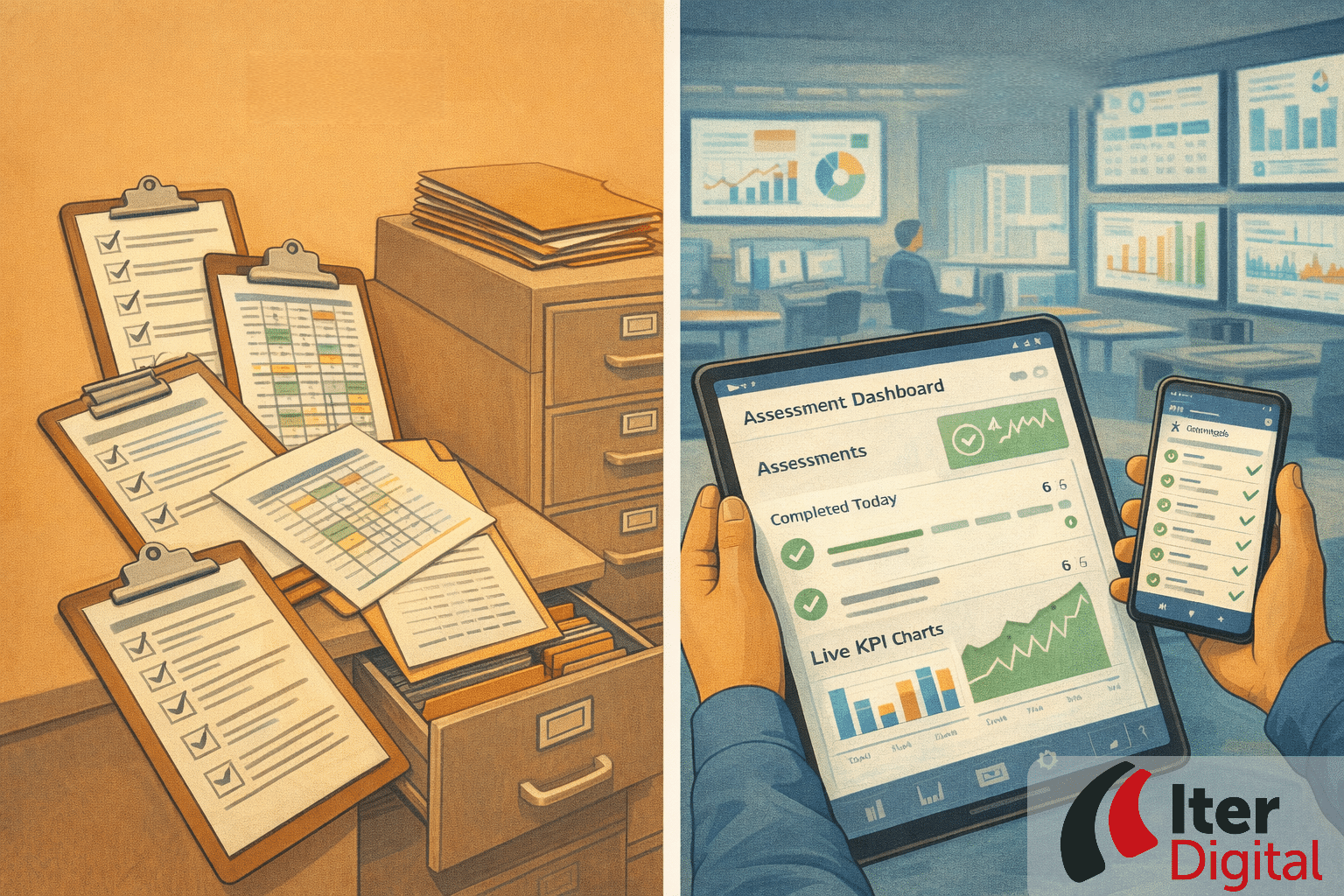
For years, operational assessments, audits, inspections, safety checks, quality reviews, and competency evaluations have lived on paper forms and sprawling Excel spreadsheets. They’ve become familiar, accepted, and embedded into day-to-day processes.
But familiarity is not the same as efficiency.
Across manufacturing, engineering, logistics, utilities, and operational environments, businesses are beginning to recognise that paper-based and spreadsheet-driven assessments are doing more than slowing teams down – they’re quietly limiting visibility, consistency, and improvement.
Digitising assessments is often viewed simply as a way to “go paperless.” In reality, the benefits run far deeper.
And importantly, this is not just an operations challenge.
Assessment-driven processes exist across the entire business:
- Operational audits
- NPI (New Product Introduction) readiness reviews
- Launch readiness assessments
- IT change readiness and deployment approvals
- Supplier evaluations
- Finance governance checks
- HR onboarding and competency reviews
Anywhere a business relies on forms, approvals, scoring, evidence gathering, or process validation, there is an opportunity to digitise, standardise, and improve.
The Obvious Benefits: Faster, Cleaner, More Efficient
The first improvements businesses notice are usually the most visible.
1. Reduced Administrative Burden
Manual assessments create manual work:
- Printing forms
- Filing paperwork
- Chasing signatures
- Re-entering data into systems
- Consolidating spreadsheets
- Correcting formatting issues
- Hunting for missing documents
Digital assessments eliminate much of this repetitive admin. Information is captured once, at source, and instantly stored in a structured format. That means less time processing information and more time acting on it.
2. Improved Accuracy
Paper forms are vulnerable to:
- Illegible handwriting
- Missed fields
- Version control problems
- Duplicate entries
- Calculation errors in spreadsheets
Digitised assessments standardise data capture through dropdowns, mandatory fields, validation rules, and automated calculations. The result is cleaner, more reliable data that decision-makers can trust.
3. Real-Time Visibility
One of the biggest frustrations with paper and Excel systems is delay. An issue identified on the shop floor may not be reviewed until days later. Reports often sit in inboxes or folders before someone notices a trend. Digital platforms allow information to become instantly visible across teams, departments, and leadership levels. Problems can be escalated faster. Actions can be assigned immediately. Trends become visible before they become costly.
4. Automated Reporting Without the Administrative Headache
One of the most underestimated burdens in paper and spreadsheet-based assessment processes is reporting. In many organisations, teams spend hours every week:
- Copying assessment data into reports
- Building PowerPoint summaries
- Updating KPI spreadsheets
- Producing audit evidence
- Chasing the latest versions
- Creating management dashboards manually
Not only is this time-consuming, but it also delays decision-making and increases the risk of errors. Digitised assessment systems can generate reports automatically in real time. Dashboards update instantly. KPIs are calculated automatically. Trends can be visualised without manual intervention. Managers can access live operational data whenever they need it. This removes a huge hidden administrative burden from operational teams and allows reporting to become a by-product of the process rather than a separate task entirely. For many businesses, this alone delivers significant time savings across management, compliance, quality, and operational functions.
5. Everyone Works From the Latest Version
One of the most common – and often invisible – problems with paper forms and Excel assessments is version control. Someone always has:
- An outdated spreadsheet saved on their desktop
- A printed version in a drawer
- An old template copied from a previous audit
- A locally edited version nobody else is using
Over time, this creates inconsistency across teams and sites. Different people answer different questions, use different scoring criteria, or follow outdated processes without even realising it. Digitised assessment platforms remove this issue entirely. Users are always presented with the latest approved version of the assessment automatically. Changes can be controlled centrally, released instantly, and rolled out consistently across the organisation. This ensures:
- Standardised assessments
- Better governance
- Improved compliance
- Reduced confusion
- More reliable reporting and benchmarking
It also removes the operational risk that comes from outdated forms continuing to circulate long after processes have changed.
Assessments Exist Across the Entire Business
When businesses think about digitising assessments, they often focus purely on operational or manufacturing use cases. But assessment-based workflows exist in almost every department.
Operations & Manufacturing
Examples include:
- Layered process audits
- Safety inspections
- Quality checks
- Asset condition assessments
- Competency evaluations
Digitisation improves visibility, responsiveness, and continuous improvement across operational environments.
NPI & Launch Readiness
New product introductions and launches often involve large numbers of disconnected spreadsheets, sign-off documents, and readiness checklists. Digitised assessments allow businesses to:
- Track launch readiness in real time
- Standardise approval gates
- Identify risks earlier
- Escalate blockers automatically
- Maintain a clear audit trail
This helps reduce delays, missed actions, and communication gaps during critical launch phases.
IT Change Readiness
IT and digital transformation projects rely heavily on readiness assessments and governance reviews. Examples include:
- Infrastructure readiness
- Cybersecurity compliance checks
- User acceptance testing
- Deployment approvals
- Change impact assessments
Digitised workflows help IT teams manage approvals more consistently while giving stakeholders visibility of project readiness and outstanding risks.
Finance
Finance teams also depend on assessment-driven processes more than many realise. Examples include:
- Budget approval workflows
- Financial control assessments
- Internal audit reviews
- Supplier financial risk evaluations
- Expense compliance checks
Digitising these processes reduces manual reporting, improves governance, and creates more traceable approval histories.
Human Resources (HR)
HR departments frequently manage assessments tied to people, capability, and compliance. Examples include:
- New starter onboarding
- Training and competency assessments
- Performance reviews
- Employee engagement surveys
- Return-to-work assessments
Digital systems improve consistency, simplify record management, and provide better visibility of workforce capability and compliance status.
The Hidden Benefits Businesses Often Overlook
While efficiency gains are important, the most valuable outcomes of digitisation are often the ones organisations do not anticipate at the start.
These hidden benefits are where real operational transformation begins.
Better Decision-Making Through Structured Data
Paper forms store information.
Digital systems create intelligence.
When assessments are digitised, businesses begin building structured datasets over time. That data can reveal:
- Recurring equipment failures
- Repeated safety non-conformances
- Training gaps
- Process bottlenecks
- Site-to-site inconsistencies
- Seasonal performance trends
Suddenly, assessments are no longer isolated documents – they become a source of operational insight. Many organisations discover they already have the answers to recurring problems hidden within years of historical assessment data. They simply never had visibility of it.
Increased Accountability Without Micromanagement
Digital assessments create transparency naturally. Actions can be assigned automatically. Completion timestamps are recorded. Escalations become traceable. Managers can see progress without constant follow-ups. This often improves accountability across teams without creating additional management pressure.
Instead of asking:
“Has this been done?”
Leaders can focus on:
“What is preventing improvement?”
That shift changes operational culture significantly.
Standardisation Across Sites and Teams
One hidden issue with paper and Excel processes is inconsistency. Different departments often use:
- Different templates
- Different scoring methods
- Different terminology
- Different reporting styles
Even when the assessment objective is the same.
Digitisation allows organisations to standardise assessment structures while still allowing flexibility where needed. This creates:
- More consistent reporting
- Easier benchmarking
- Better compliance alignment
- Improved audit readiness
- Faster onboarding for new staff
In multi-site operations, this can be transformational.
Easier Compliance and Audit Preparation
Preparing for audits using paper systems is rarely straightforward. Teams often spend days:
- Searching for records
- Verifying versions
- Rebuilding evidence trails
- Chasing missing signatures
Digital assessments automatically create searchable, time-stamped records with clear audit histories. For regulated industries, this dramatically reduces stress and preparation time while improving confidence during inspections.
Enhanced Engagement on the Front Line
Many organisations assume digital systems are primarily for management reporting. In reality, frontline teams often benefit the most. Modern digital assessment tools can:
- Simplify data entry
- Reduce repetitive paperwork
- Allow mobile completion
- Enable photo capture
- Provide guided workflows
- Reduce duplication of effort
When implemented properly, digitisation can remove friction from daily tasks rather than adding to it. This is especially valuable in operational environments where time and attention are critical.
Faster Continuous Improvement Cycles
Continuous improvement depends on visibility and speed. Paper systems slow both down. By digitising assessments, organisations shorten the time between:
- Identifying an issue
- Understanding root causes
- Assigning actions
- Implementing improvements
- Measuring results
That acceleration creates a more responsive operation overall. Instead of reactive problem-solving, businesses can move towards proactive improvement.
Scalability Without Complexity
As businesses grow, paper and spreadsheet systems become increasingly difficult to manage. Files multiply. Versions become harder to control. Reporting becomes fragmented. Knowledge becomes dependent on individuals. Digitised assessment platforms create scalable frameworks that grow with the organisation. New sites, teams, processes, or assessment types can often be introduced without rebuilding systems from scratch.
The Real Shift: From Record Keeping to Operational Intelligence
Perhaps the biggest hidden benefit of digitising assessments is the mindset change it creates. Traditional assessments are often viewed as administrative exercises:
- “Something we have to complete”
- “Something for compliance”
- “Something to file away”
Digital assessments transform them into operational tools that actively support performance improvement. The assessment itself becomes only the starting point. The real value comes from what the organisation can learn, track, improve, and predict afterwards.
Digitisation Is Not About Replacing People
There is sometimes concern that digitisation removes the human element from operational processes. In practice, the opposite is usually true. When teams spend less time handling paperwork, spreadsheets, version control issues, and manual reporting, they gain more time for:
- Coaching
- Problem-solving
- Collaboration
- Improvement activity
- Decision-making
Technology should support operational expertise – not replace it.
Final Thoughts
Paper forms and Excel spreadsheets were never designed to provide real-time operational intelligence across modern businesses. They were designed to record information.
Today’s operational environments require more than record keeping. They require visibility, consistency, traceability, responsiveness, and insight.
And those needs extend far beyond the shop floor. From operations and manufacturing through to IT, HR, finance, governance, and product launches, assessment-driven processes sit at the heart of how businesses manage risk, readiness, compliance, and performance.
Digitising assessments is not simply a technology upgrade. It is a shift towards smarter operations, better decision-making, and more sustainable continuous improvement across the entire organisation. And for many businesses, the hidden benefits become far more valuable than the original reason they started.
About the Author

Emma Bowler
Emma brings a unique blend of operational and technical experience, having worked across both manufacturing operations and IT. This combination gives her a practical understanding of the challenges organisations face when adopting digital solutions and driving continuous improvement.