
Jun 24 2026 | Insights | Emma Bowler
Why Your Problem Solving Process Isn’t Solving Problems
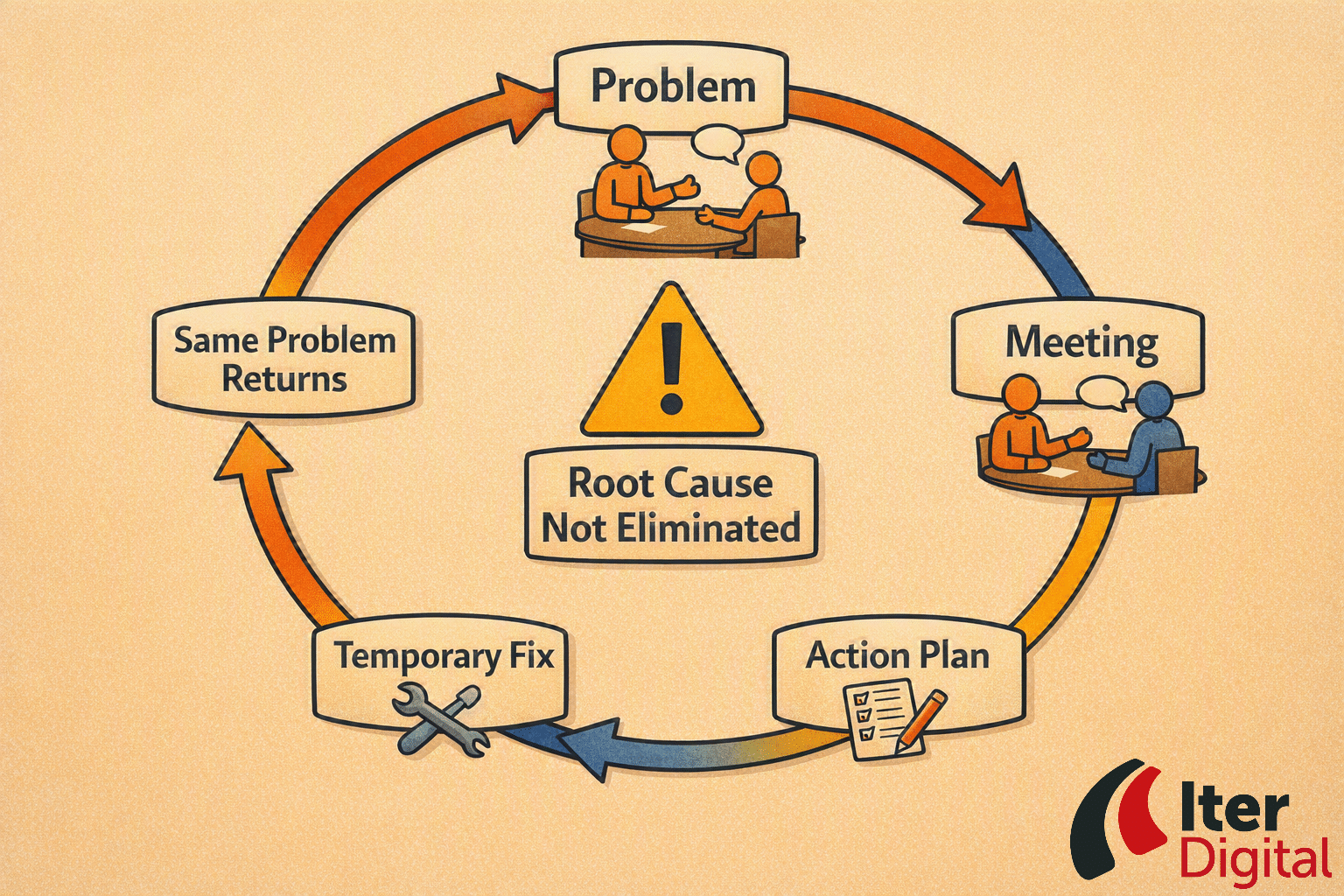
Manufacturing organisations invest significant time and effort into solving problems. Teams meet daily to review performance, discuss issues and agree corrective actions. Yet many of the same problems continue to reappear. A quality defect that was supposedly resolved returns a few weeks later. A machine that caused downtime last month causes downtime again this month. A recurring delivery issue continues to impact customer service despite repeated interventions.
The frustrating reality for many operations leaders is that they are not suffering from a lack of problem-solving activity. They are suffering from ineffective problem-solving processes.
The issue is rarely that people do not care. Most teams work hard to address operational challenges. The problem is that organisations often focus on treating symptoms rather than eliminating root causes.
If the same issues continue to return, it may be time to question whether your problem-solving process is actually solving problems.
The Illusion of Progress
Many manufacturing sites appear busy when problems occur.
Meetings are scheduled. Investigations begin. Action plans are created. Responsibilities are assigned.
On the surface, everything looks positive.
The problem is that activity can easily be mistaken for progress.
When a production issue occurs, there is often pressure to find a solution quickly. Customers are waiting, targets are being missed and management wants answers.
As a result, teams frequently jump straight into corrective actions before fully understanding what caused the problem in the first place.
The issue may temporarily disappear, creating the impression that the problem has been solved. However, because the root cause remains, the issue eventually returns.
This cycle repeats itself again and again, consuming valuable time and resources.
Mistake 1: Jumping Straight to Solutions
One of the most common mistakes in manufacturing problem solving is starting with a solution instead of a problem definition.
Imagine a production line experiencing repeated downtime. Within minutes, suggestions begin to emerge:
“The machine needs servicing.”
“We need additional training.”
“The maintenance schedule isn’t robust enough.”
“The supplier quality is poor.”
These suggestions may ultimately prove correct. The problem is that they are assumptions. Without evidence, organisations risk implementing solutions that address symptoms rather than causes. Effective problem solving requires teams to slow down and understand what is actually happening before deciding what needs to change. The most successful organisations spend more time understanding the problem than they do debating solutions.
Mistake 2: Poor Problem Definition
A surprising number of investigations begin with vague problem statements.
Examples include:
- Downtime is too high.
- Quality is poor.
- Productivity is falling.
- Customer complaints are increasing.
These statements highlight concerns, but they do not define problems. A well-defined problem should be specific, measurable and supported by data.
For example:
“Line 3 experienced 18 hours of unplanned downtime during the last four weeks, with 62% attributed to sensor failures on Station 4.”
This level of detail immediately focuses the investigation. Without clear problem definition, teams often spend time discussing symptoms, opinions and assumptions rather than facts. The result is inconsistency, confusion and ineffective corrective actions.
Mistake 3: Root Cause Analysis Becomes a Tick-Box Exercise
Most organisations are familiar with tools such as:
- 5 Whys
- Fishbone Diagrams
- A3 Problem Solving
- PDCA
- 8D
The challenge is not awareness. The challenge is application. Too often, root cause analysis becomes a formality rather than a genuine investigation. Teams complete templates because the process requires it, not because they are determined to understand the underlying causes. When this happens, root causes are often superficial.
For example:
Problem: Production line stopped.
Root cause: Operator error.
But why did the operator make the error?
Was training inadequate?
Was the process unclear?
Was the standard work outdated?
Was the equipment interface confusing?
Was there excessive workload pressure?
Stopping at the first answer rarely reveals the true cause.
Organisations that consistently improve performance are those that maintain curiosity and continue asking questions until evidence confirms the root cause.
Mistake 4: Lack of Ownership
Even when investigations identify genuine root causes, many organisations struggle to implement effective corrective actions.
A common reason is unclear ownership.
Actions are recorded during meetings but responsibility is not properly assigned.
Deadlines are agreed but not reviewed.
Weeks later, teams discover that actions remain incomplete.
This creates frustration and erodes confidence in the entire problem-solving process.
Effective problem solving requires clear accountability.
Every action should have:
- A named owner
- A defined completion date
- A measurable outcome
- Regular review
Without ownership, even the best investigations fail to deliver results.
Mistake 5: No Verification of Effectiveness
Many organisations stop monitoring a problem once corrective actions have been completed. Unfortunately, completion does not equal success.
A maintenance improvement may have been implemented exactly as planned, but did it actually reduce downtime?
A process change may have been introduced, but did it eliminate the quality defect?
Without verification, organisations cannot know whether corrective actions were effective.
This is why structured methodologies emphasise follow-up and validation. The objective is not simply to complete actions. The objective is to prevent recurrence.
Verification ensures that improvements are delivering measurable results rather than simply creating additional activity.
The Hidden Impact of Spreadsheet-Based Problem Solving
Many manufacturers continue to manage problem-solving activities using spreadsheets, emails and paper-based systems. While these tools may appear convenient, they often introduce significant challenges.
- Information becomes fragmented across multiple locations.
- Different versions of action plans circulate among departments.
- Historical investigations become difficult to access.
- Management visibility is limited.
- Most importantly, accountability becomes harder to maintain.
When actions are stored in disconnected systems, it becomes difficult to track progress, escalate overdue tasks and verify outcomes. As organisations grow, these challenges become increasingly significant.
What Effective Problem Solving Looks Like
The most successful manufacturers share several common characteristics.
They use a consistent methodology across the organisation.
They define problems using data rather than assumptions.
They focus on root causes rather than symptoms.
They establish clear ownership for every action.
They regularly review progress.
They verify effectiveness before closing investigations.
Most importantly, they create visibility.
Everyone understands what problems exist, who is responsible for resolving them and what progress is being made.
This visibility drives accountability and ensures that improvement activities remain a priority.
Building a Culture of Continuous Improvement
Problem solving should not be viewed as a standalone activity. It should form part of a broader culture of continuous improvement. When organisations consistently identify issues, investigate root causes and implement sustainable solutions, performance improves over time.
Quality improves.
Downtime reduces.
Delivery performance strengthens.
Employee engagement increases.
Continuous improvement becomes embedded within everyday operations rather than being treated as a separate initiative. The organisations that achieve the greatest success are not necessarily those with the fewest problems. They are the organisations that have developed the capability to solve problems effectively.
Conclusion
If the same operational issues continue to return, the problem may not be your people, your equipment or your processes. The problem may be the way problems are being solved.
Effective problem solving requires structure, discipline and accountability. It requires organisations to move beyond assumptions, focus on root causes and verify that corrective actions genuinely prevent recurrence.
Technology alone will not solve problems. However, when combined with a structured methodology, it can significantly improve visibility, accountability and consistency across the organisation.
Manufacturers that achieve sustainable improvements are those that make problem solving part of their daily operating system rather than treating it as a standalone activity. By digitising structured problem solving, organisations can ensure that investigations are followed through, actions are completed and lessons learned are shared across teams and sites.
At Iter Digital, we help manufacturers embed these behaviours through digital Lean applications that support structured problem solving, daily management and continuous improvement. The result is fewer recurring issues, faster resolution times and greater confidence that improvements will be sustained.
The goal is not simply to solve today’s issue.
The goal is to ensure that the same issue never becomes tomorrow’s problem.
About the Author

Emma Bowler
Emma brings a unique blend of operational and technical experience, having worked across both manufacturing operations and IT. This combination gives her a practical understanding of the challenges organisations face when adopting digital solutions and driving continuous improvement.